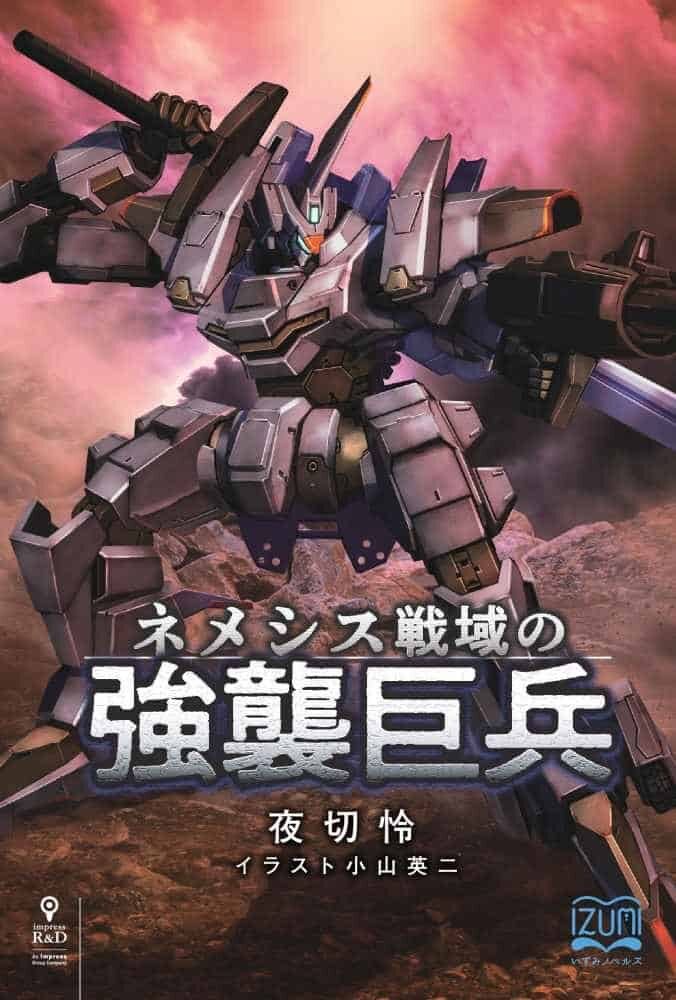
Assault Colossus of the Nemesis Warfront
Novel Info

Summary

... Read More

Mozuya Kou is a twenty-two-year-old factory worker who manufactures automobile parts. His life changes abruptly when an emergency alarm sounds at his workplace. While colleagues rush toward a military aircraft for evacuation, Kou’s senior coworker, Yoshikawa, spitefully throws him out of the closing plane door just before departure. Left behind in a desolate wasteland filled with rubble and giant humanoid silhouettes, Kou witnesses a massive mantis-like machine shooting down survivors. Overwhelmed and seeking refuge, he is guided by a talking Russian Blue cat through a hidden entrance into an underground facility.

Inside the facility, Kou learns that the cat is a machine named Master. After consuming a capsule administered by the cat, Kou awakens to find he can understand the cat’s speech. Master explains that Kou and the other factory workers have been transported from the twenty-first century to a planet in the far future, more than twenty thousand years ahead of their original time. The star system is centered on a red dwarf named Nemesis, located in what was once the outer edge of the Solar System. Earth was destroyed by a celestial collision, and humanity had migrated to this new system through quantum data transfer orchestrated by supercomputers called Sophia.

The facility Kou finds himself in is a former weapons factory and junkyard for combat mechs known as Silhouettes. Master reveals that humanity is currently fighting a war against the Stones, remnants of human consciousness uploaded into data that seek to eliminate biological life. These Stones command unmanned killer machines called Murders, such as the Mantis-type Keres Kou encountered outside. Master, nearing the end of his operational lifespan, urges Kou to pilot a Silhouette to survive.

Kou discovers a specific unit, the TSW-R1 05, nicknamed Lanius, which is abandoned in a pile of scrap. This unit previously went out of control to protect humans without a pilot. Against Master’s initial hesitation, Kou boards the mech. The unit’s operating system, Fennel, scans Kou’s biometric data and instantly registers him as the pilot, optimizing its language settings for his Japanese background. Kou undergoes a crash course in piloting, learning to use the machine’s high-dimensional projection armor and its heavy great sword. He learns that melee combat is more effective in this era due to the nature of the armor technology.

Kou faces the Mantis-type Keres in battle. Utilizing a scrapped Silhouette as a shield and employing techniques from his hobby of battoujutsu, he manages to close the distance and destroy the enemy machine. Following the victory, Kou experiences a vivid dream or vision in which he meets a young girl named Ashia. She grants him the qualifications of a Development Engineer, also known as a Bricoleur or handyman, allowing him to repair and modify machinery. She asks him to eventually find her, then disappears.

Master confirms that Ashia is the Super AI managing the planet Ashia. He explains the broader context: the Sophia computers self-destructed after humanity reused their technology to wage interplanetary wars, leading to civilization collapsing twice. The current inhabitants are struggling to rebuild while defending against the Stones. Master reveals his own origin as a Telema AI companion and expresses a desire to reach a sealed arsenal factory deep within enemy territory before he shuts down. Kou, committed to helping his new companion, chooses to journey to this facility despite the extreme danger, beginning his role as a mechanic and pilot in this ruined world.

As they travel across the wasteland, Kou and Master pick up radio signals from human resistance groups broadcasting music and information. Kou learns that humanity is scattered across three planets in the Nemesis system, all under threat. The journey ahead will require Kou to utilize his new engineer abilities to maintain and upgrade Lanius while navigating hostile territory. His background in swordsmanship and manufacturing proves relevant to his survival, bridging the gap between his past life and his new reality. The story establishes his primary goal: reaching the arsenal, strengthening his machine, and uncovering the truth behind the ongoing war and the nature of the Stones.

Kou’s integration into this future society is just beginning. He must learn to operate within the fragmented human communities that remain, interact with other specialized beings like Therianthropes and Nereids, and confront the ideological divide between those who resist the Stones and those who collaborate with them. The bond between Kou and Master serves as the emotional anchor of the narrative, driving their perilous mission forward. The vast technological disparity between Kou’s understanding and the advanced machinery he pilots creates both comedic and dramatic tension as he adapts to his new existence.

The immediate threat of the Stones looms over every step of their journey. Kou must rely on his quick thinking and the combat skills he has barely begun to master. The ruins they traverse hold both danger and opportunity, containing parts and technologies from a lost age. Kou’s unique status as a transfer from the past, combined with his engineering aptitude, makes him a valuable asset to the resistance. The narrative sets the stage for a prolonged struggle for survival and the restoration of a broken world, with Kou and his mechanical companions at the forefront of the effort.

Latest Release
DateGroupRelease
2026-10-01light novels translations c443
2026-10-01light novels translations c442
2026-10-01light novels translations c441
2026-10-01light novels translations c440
2026-10-01light novels translations c439
2026-10-01light novels translations c438
2026-10-01light novels translations c437
2026-10-01light novels translations c436
2026-10-01light novels translations c435
2026-10-01light novels translations c434
2026-10-01light novels translations c433
2026-10-01light novels translations c432

Community Reviews

Rating(4.3 / 5.0, 41votes)
5 stars
23(56%)
4 stars
8(20%)
3 stars
10(24%)
2 stars
0(0%)
1 stars
0(0%)

Popular reviews

... Read More
OK let me just be honest — this section made my heart rate go UP. Not because of action scenes (there are basically none here), but because of what we LEARN about the conflict. And the learning itself is what's tense. Let's talk stakes layer by layer: Layer 1: The Stones are invading three planets. They have unmanned weapon armies. They hunt humans to brainwash them into serving their mechanical society. This is dystopian-level bad. Layer 2: The Super AIs created both the Murders AND the Silhouettes. The creatures designed to protect humanity are now attacking it. That betrayal cuts deep — it's not just an external enemy, it's a corrupted guardian. Layer 3: Kou and Master are heading INTO enemy territory. Not toward safety. Not toward reinforcements. They're going into the heart of hostile space to reach a sealed arsenal factory. Master essentially says "it'll take more than 10 days" and Kou replies "Gotcha. Better get moving then." The casual acceptance of danger here is chilling in the best way. Layer 4: The radio program scene. A female voice singing soothing melodies while they cross a warzone. It's beautiful and terrifying at the same time — because Master immediately notes that such broadcasts mean a large military force is nearby. Entertainment exists, but it's guarded by weapons. Peace is temporary and armed. The suspense technique here is interesting. The author doesn't give us a fight scene to release tension — they INCREASE it by having Kou reflect on his sword practice. "He'd swung his sword every single day... techniques to deal with enemies, techniques for pressing on the attack, counter techniques... He practiced them to better himself." This is the calm before violence, and it works because we know exactly what he's preparing for. And the final line cuts off mid-thought — "he couldn't afford to hesitate when u" — which is a classic cliffhanger. My fingers literally hovered over the next page. I needed to know what happened next.
... Read More
OK so let me just say this straight — the way this arc is structured is actually really smart. You have the big-picture strategic setup with Jenny giving orders, then you cut to Kou on the ground doing his thing, and then you go back to the tank crew holding the line. It's like three separate threads that all tie into one desperate defense, and they're all running out of time at the same time. What really sold me was the Enyo reveal. It's described as a super-giant ant-shaped weapon platform, right? One shot and it turns a heavily armored tank into scrap metal. But the tank crew can't even scratch it. That's the whole problem — they're fighting a war where the enemy scales up endlessly. The writer doesn't need to over-explain; the imagery does the work. A single tank magazine has 48 rounds. Forty-eight. Against an army. The plot also quietly raises the question of what happens if the Stones capture the A-Carbuncle. Remember when Master explains that the dome's structural integrity depends on it? That building that gets hit by railgun fire doesn't even flinch because of the energy. If that power source goes down, the whole place collapses. So it's not just about winning the battle — it's about survival infrastructure. That stakes escalation from 'defend the dome' to 'don't let the power core get stolen' is subtle but effective.
... Read More
I need to talk about this partnership because honestly it's one of the most fun dynamics I've read in a while and nobody is giving it enough credit. Master is this incredibly knowledgeable, somewhat exasperated AI entity who has to explain literally everything to Kou, who is apparently brand new to piloting a robot. And yet — and YET — the moment Kou says 'You're cute too, Master,' the thing loses its absolute mind and yells 'Nyaaaaa!' That is the single funniest character beat in these chapters and I cannot stop smiling about it. Here's this terrifying war machine AI that just explained to you how fifth-dimensional projection armor works, and it gets flustered by a compliment like a middle schooler. It completely undermines its own gravitas in the best possible way. But what I actually find more interesting is how Kou treats Master. He's not intimidated. He's not treating it like a tool or a god or whatever. He's teasing it. There's this whole section where Master is feeding him combat data with this impatient tone — 'I'll tell you the details later. It's very difficult to explain it clearly' — and Kou just absorbs it all without panic. He's nervous about the fight, sure, but he trusts Master to have his back. Meanwhile Master's doing that thing where it pretends not to care but clearly does, like bringing up that Silhouette operators are usually beautiful girls and then immediately getting defensive when Kou sidesteps the comment entirely. The dynamic writes itself honestly. They're already a team by chapter 20 and they've only known each other for a day.
... Read More
This batch does something really smart with its pacing. It opens at FULL SPEED—railgun shots, Enyo taking damage, Telkhines closing in, pile bunker dispatch. All within the first page or two. Then it CUTS to Kou's perspective and suddenly we're in a completely different rhythm: dialogue-heavy, tactical discussion about enemy recovery methods, logistics, rewards. The tension drops but the story deepens. Then the Hangar Carrier scene—a genuine breather. Repair dialogue, meeting Blue, the awkward break room moment, Lozere's capsule scene. It's quiet but never boring because the character interactions carry it. And then—just as you settle in—Blue gets her unit reconfigured, they head back out, and the final section kicks into gear again with the enemy numbers dropping but the remaining forces getting more dangerous. Ant Commanders approaching, Blue struggling with magazine changes, a Telkhines with a large sword appearing mid-fight. The chapter ends right as things are about to get tense again. The structure is basically: Action → Tactical Breather → Character Moment → Reload → Action. It never lets you get comfortable, but it also never exhausts you. Classic serial pacing done right.
... Read More
Let's talk about how these characters actually sound because I was worried this might be stiff or awkward given how much exposition is required. Spoiler: it's not. The dialogue has personality and each character has a distinct voice. Master's voice is probably my favorite. The cat is dry, impatient, occasionally cruel, but underneath there's genuine care. Lines like "Oi, oi. Don't panic kid" and "Please just give up" when Kou asks about smartphones show a character who's seen too much and has zero patience for basic human needs. But then Master also says things like "I will lead you safely to humanity's bastion. I'm sorry, but I will have to speed up the explanations" and you can hear the guilt underneath the brusque exterior. The dual tone works beautifully. Kou's dialogue feels authentic for a regular guy in an impossible situation. He's not philosophical or witty—he's confused, scared, and reactive. When Master tells him about the Silhouettes, Kou's first response is basically "So I'll instantly know how to fight after boarding a robot? What is this? An anime?" That's such a natural, self-aware reaction. He acknowledges the absurdity instead of pretending it's normal. The betrayal scene with Yoshikawa is short but effective. Yoshikawa doesn't get much dialogue but his actions speak volumes. The contrast between his silent betrayal and his loud performance after Kou is thrown out is sharp writing. We don't need paragraphs from him—we get what we need in three lines of screaming. One thing I appreciate is how the dialogue carries exposition without feeling like a lecture. Master explains the Silhouettes, the Keres, the future timeline—all through conversation that has rhythm and texture. The back-and-forth between Kou's questions and Master's answers has a natural cadence. And the humor lands. Lines like Master chuckling about English being the universal language because of the internet are clever worldbuilding delivered as wit rather than info-dump. The narrative voice itself is straightforward and functional, which suits the story. It doesn't try to be literary—it tells the story and lets the dialogue do the heavy lifting. That's the right call for this type of narrative. The voices are distinct enough that I can tell who's speaking without tags, which is a sign of solid character writing. Honestly, if the action matches the quality of the dialogue, this series is going to be something special.
... Read More
Okay so the whole sequence where Kou takes on the Enyo alone is genuinely one of those moments where I had to pause and just... appreciate the storytelling. You've got the coordination with Jenny—she takes out the chest with missiles to draw all the enemy fire away, then Kou goes in hot with Unit 5, shatters the head in one swing, rides the tail swipe, and bails. That's not just action, that's choreography. Every beat lands. But what really made it work for me was the setup. The author didn't just drop us into the fight cold. We spent time understanding the rules first—Kou explaining that the Whis power unit is on the chest, the discussion about why silhouettes are needed instead of regular AI, the reconnaissance beat where they figure out the plan. It gave the climax weight because I actually understood what was at stake before the sword came down. And then the shift to the Sniper Girl's POV? Genius. It pulled us out of Kou's head just as the dust was settling and introduced a whole new perspective on the same battle. I could literally see her reaction: "Eh! What the heck was that...?" She witnesses everything from her angle and it validates how insane Kou's solo move was, but from the outside. That's a smart structural choice. The only thing I'd flag is the transition into the sniper scene feels a tiny bit abrupt—like the chapter cuts off right as she fires. But honestly, that cliffhanger is doing heavy lifting for the next chapter. I wanted to know what happened immediately.
See all reviews

Custom lists

See all custom Lists