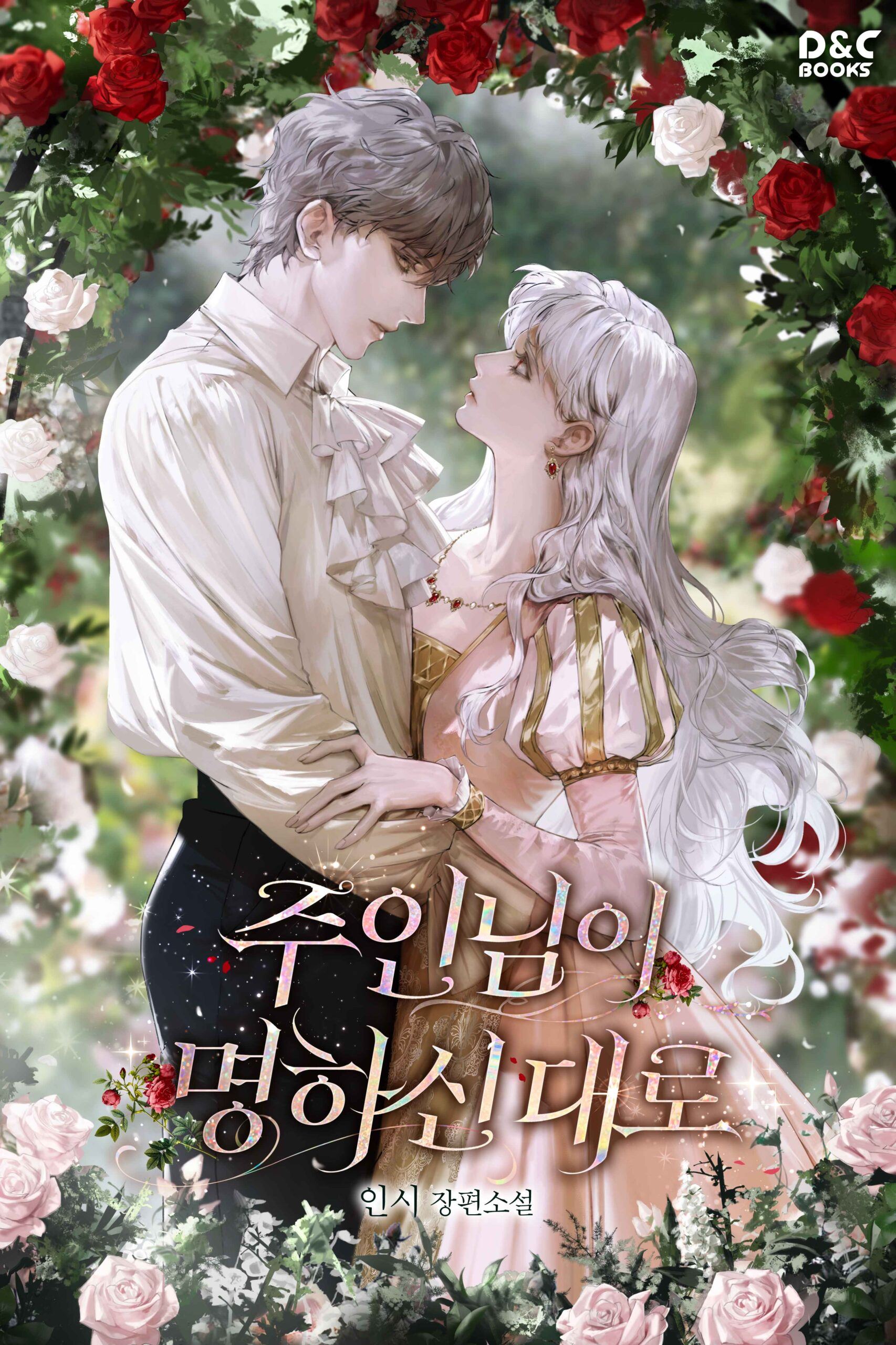
As My Lady Commands
+Add to Custom List
Genres:
Novel Info
  • Author:
  • Status:Ongoing

Summary

... Read More

Astrina Loendis is the bastard daughter of King Cherman of Loendis, born to a maid and distinguished by the royal red eyes that mark her lineage. After her mother dies under suspicious circumstances shortly after Astrina displays exceptional intelligence, she receives a warning teacup from the queen, signaling that her mother’s death was murder. Realizing that brilliance is a death sentence in the treacherous royal court, Astrina feigns madness to survive. She lowers herself to the status of a harmless, simple-minded fool, allowing her brother, Crown Prince Lien, to use her as a prop to bolster his own image as a compassionate heir. For six years, she endures isolation in the North Tower, playing the role of the court jester while secretly gathering information and maintaining her sanity beneath a mask of idiocy.

The central conflict ignites when Lien gifts Astrina a slave boy, Yan, who is revealed to be the last prince of the defeated Nashakh tribe. Yan possesses golden eyes and a fierce, untamable spirit. Initially, Astrina suspects he is a spy sent by Lien to monitor her, subjecting him to psychological warfare and physical torment to test his loyalty. However, her assumptions shatter when she challenges him to a hunting game where he is the prey. Yan manages to evade a trained knight and returns at dusk, having survived. He refuses Lien’s manipulation, asking only for freedom. Astrina recognizes him as an ally unlike any other—someone who belongs to no one but himself—and proposes a wager: if he can escape the palace, she will grant him his freedom; if he fails, he becomes her loyal dog. Yan attempts to flee but is caught and severely beaten.

Instead of allowing Lien to execute the runaway slave, Astrina intervenes, claiming Yan as her own pet to be tamed. She forces him to submit, renaming him Yan, which means "star" in their ancient tongue. Despite the hostility between their peoples, a complex dynamic forms. Astrina continues her act of madness publicly but reveals glimpses of her sharp intellect and hidden vulnerabilities privately. Yan, initially filled with hatred, begins to notice her self-harm and the severe monthly illness that causes her to cough blood. He discovers she is poisoning herself deliberately, likely as a method of contraception or a cry for control in a life devoid of autonomy. The boundary between captor and captive blurs as Yan tends to her needs, observing her loneliness and the tragic parallels between her cage and his own enslavement.

Key turning points occur during a royal lecture where Astrina is forced to participate. When scholars demand answers she cannot give without breaking character, Yan is beaten in her place. Astrina pretends to faint to stop the brutality, sparing Yan further harm but deepening his confusion about her true nature. Later, Yan witnesses Astrina suffering from her painful monthly condition and confronts her. She lashes out, accusing him of spying, but the incident reveals the depth of her physical and emotional pain. Yan begins to suspect that Astrina’s madness is a calculated performance, a survival mechanism similar to his own endurance. He starts to protect her secretly, bringing her medicine and watching over her during her vulnerable moments.

The story direction shifts as external political tensions rise. Loendis is engaged in a war of conquest against the northern tribes, and Lien’s ambition grows. Astrina deduces that her father’s health is failing and that a succession war is imminent. She realizes that her feigned insanity is no longer enough to guarantee her safety; she must become a player in the political game. Yan, torn between his duty to his fallen people and his growing attachment to Astrina, becomes her primary confidant and protector. Their relationship evolves from master and slave to partners in a dangerous dance. Astrina prepares to shed her mask, intending to use Yan’s knowledge of the north and his warrior skills to navigate the impending coup. The narrative sets the stage for Astrina to reclaim her agency, leveraging her seemingly useless position to strike at the heart of the Loendis royalty, with Yan as both her weapon and her only true equal.

Latest Release
DateGroupRelease
2026-10-03dusk blossoms c22
2026-10-03dusk blossoms c21
2026-10-03dusk blossoms c20
2026-10-03dusk blossoms c19
2026-10-03dusk blossoms c18
2026-10-03dusk blossoms c17
2026-10-03dusk blossoms c16
2026-10-03dusk blossoms c15
2026-10-03dusk blossoms c14
2026-10-03dusk blossoms c13
2026-10-03dusk blossoms c12
2026-10-03dusk blossoms c11

Community Reviews

Rating(0 / 5.0, 40votes)
5 stars
0(0%)
4 stars
0(0%)
3 stars
0(0%)
2 stars
0(0%)
1 stars
0(0%)

Popular reviews

... Read More
The white canary. That metaphor just landed on me like a brick. "His foolish, pitiable white canary." Astrina compared to a pet bird—kept alive because someone fond of her enjoys having her around, but entirely at the mercy of whoever holds the cage. And the fact that Celestia only figures this out in a single silent moment, watching a cloud obscure the sun, makes the realization feel earned rather than explained. But the deeper symbolism is in what everyone keeps doing with restraint. The boy has a device that controls him—Lien gave it to Astrina, which is itself a power play. Astrina wears a ring she turns over and over, a nervous habit that might or might not have its own significance. The maids are restrained by fear of the queen. Winzel can't leave her post because the physician's diagnosis keeps Astrina alive, and the queen keeps Winzel watching. Everyone in this story is bound by something, and the only question is whether they're holding the rope or being held by it. Then there's the horse-riding detail. Astrina has never learned to ride. A princess who can't even mount a horse, kept in a tower, allowed out only under surveillance, proposed as a marriage candidate to a distant kingdom—as though she were livestock being traded. The fact that she once was "sharper than the crown prince himself" and now can't even catch a chicken with a slingshot—that's not just a tragedy, it's evidence. Her madness didn't just happen; something happened to her. The Loendis royal power that might one day manifest in her, the queen's terror of it, the suggestion that if she'd been sane the queen would have killed her already... the system that produced this princess is just as culpable as the crown prince who keeps her caged. And the boy—Nashakh, meaning "strong," a people who "break before they bend"—choosing to comply. Is that strength or submission? The text won't tell us, and that uncertainty is the point.
... Read More
I have to address the structural genius of this batch because the pacing is absolutely ruthless and I respect it enormously. Let me walk through the architecture here. We open with Yan's offer — a moment of warmth, possibility, hope. Astrina's internal monologue about wanting to be like him, about finding a path after wandering in fog. This is the SETUP. The reader is lulled into thinking maybe, just maybe, things are about to get better. Then BOOM. Lien appears with the engagement news. The entire tone shifts from hopeful to claustrophobic in one paragraph. 'If you refuse the engagement, I'll kill your dog.' That line. That is the narrative equivalent of a door slamming shut. And then the reveal that Yan was placed there by Lien all along? That's a second hammer blow on top of the first. The structure here is deliberate — each revelation comes faster, harder, with less breathing room. But then the author does something clever. After this crushing sequence, we cut to Yan and Astrina in their new quarters in the central palace. A quieter moment. The engagement drama has resolved (Astrina accepted it, apparently), and now we're in a calmer surface-level scene where they're just... existing together. This is the false calm before the real storm. And then Yan finds the passage. The tension spikes again. The escape sequence — this is where the pacing becomes surgical. Every sentence gets shorter, more urgent. 'There was not much time.' 'Go, quickly.' The prose itself seems to accelerate. They reach the entrance. The chains come off. And then the breakup. Not a dramatic confrontation — just two people who understand too much to say what they feel. The chapter ends with Astrina's laugh. After all that buildup, all that tension, all that heartbreaking silence at the passage — she laughs. And then we cut to Yan's perspective with Lien burning a note. The structural shift from Astrina's emotional release to Yan's cold, calculated world is jarring by design. The author is telling us: your relief was premature. The war isn't over. It's just beginning. This is masterclass tension management. I started this batch desperate for hope and ended it with my stomach in knots.
... Read More
I need to talk about how Astrina's dialogue shifts when she stops performing for people. All chapter she's been this bright, singsong princess to everyone — 'Brother! I've missed you so much!' — but then she walks into the storage room and yells 'I've never lost to anyone my age' and then 'Then could you win against a lion?' and it's so different from anything we've heard from her. And Yan's line 'There was no particular reason. I just…' — he trails off. He can't even articulate his own kindness. That's such honest writing. The boy who was trained to be a weapon and an instrument of revenge can't explain why he put a cold cloth on a girl's forehead. He just says it 'felt like the thing to do.' The most brutal exchange in this whole section is Astrina saying 'I'm not going to thank you' and Yan responding 'I didn't want you to' and then she adds 'So don't forgive me either.' Like she's protecting him from having to choose a side. Or maybe protecting herself from hoping. Both interpretations work and that's what makes it good dialogue — it carries multiple truths at once. Lien's voice is also fascinatingly flat. He talks about hunting foxes and deer while his sister is possibly dying in a tower, and his smile is described as 'cool, like something casting a shadow.' He's not evil in a theatrical way. He's just casually monstrous. Which is way worse.
... Read More
The pacing in this batch is so deliberate and I keep coming back to how it mirrors Astrina's fever state. The whole night sequence drags — Yan can't sleep, gets sharper, moves through the dark corridor, finds her not breathing properly. It feels SLOW on purpose, like you're living inside the anxiety. The author doesn't speed up even when Yan nearly kills her. You're meant to sit in that tension. Then the morning after, she wakes up, remembers fragments, summons him, and asks 'Why didn't you hurt me? Are you a good person?' — and Yan basically wants to walk out of the room. This quiet, awkward exchange contrasts so sharply with what comes next. Lien's visit is paced like a slow poison itself. Starts casual, hunting stories, snow, tea — then the teacup reflection, the question about Yan, the smile that's 'like something casting a shadow.' By the time Astrina rushes to the storage room gasping 'Can you use a sword?' the reader is already bracing for impact. And then the lion question lands like a guillotine. The final line of the text cuts off mid-sentence — 'The answer a foolish, obedient princess was supposed to give had been deci' — and it's perfect cliffhander writing because we don't even get to finish the word 'decided.' We're left hanging on the edge with both of them.
... Read More
The dialogue in this batch is CHILLING. Not because it's overly dramatic or full of grand speeches, but because of what's LEFT UNSAID. Lien's voice is perhaps the most carefully constructed in the entire book, and I need to dissect it. Let me start with the scene where he visits Astrina in the dungeon. He says: "You must have been in so much pain, Asti." On the surface, this sounds like genuine concern. But read it again. He's crying. He's expressing sympathy WHILE he's the one who ordered her torture. The dissonance between his words and his actions is the entire point—he genuinely believes he's being compassionate. That's what makes him so terrifying. He's not a mustache-twirling villain. He's someone who has rationalized atrocity into an act of love. Then: "Don't make me be a worse brother than I already am, Asti." This line. This LINE. He's framing his cruelty as restraint. As if the alternative would be even worse (and we know it would—because the mage was about to do something far more invasive). He's positioning himself as the lesser evil, the protective brother, when he's literally the source of all the evil. And the worst part? The text says: "He had spoken in a clearly gentle tone, and still Astrina felt a chill." GENTLE. The man torturing her is being GENTLE. That gentleness is the weapon. Now compare this to Yan's internal monologue. His voice is completely different—more direct, more raw, less filtered. When he thinks about Astrina, it's not calculated. It's sudden and aching: "The princess who was as white as the snow here, looking as though she might melt at any moment." This isn't dialogue, but it reveals his voice—poetic, tender, vulnerable. And then the juxtaposition with his later thought: "I would let her go, free, wherever she wanted." Selfless. Unlike Lien, who wants to possess and control. The mage's dialogue is sparse but significant: "The power to place a strong suggestion and control a person, or to rummage through someone's mind at will, isn't that something worth fearing?" This is Lien speaking, actually—not the mage. He's explaining magic to Astrina while it's being done TO her. It's another layer of violation: she can't even be ignorant. He makes her UNDERSTAND what's happening before it happens. Sir Ralph's reporting is stiff, formal—typical knight speech. But the moment he leaves Lien's presence, the narration tells us: "Ralph was seized by the feeling that he had done something terribly wrong." He didn't say anything wrong. He just spoke TRUTH to a monster and felt contaminated by it. Astrina's dialogue is mostly silence—which IS her dialogue. Her refusal to speak is her most powerful line. And when she finally does speak, it's not words but a scream: "No, it's not Mohen! The northern coalition is stationed at Volancer!" This is the moment her voice breaks through the magical suppression, and it's devastating because we know it's too late. Yan's only spoken lines at the end are broken mutterings: "What is that..." "No." "Loendis..." The dissolution of his speech mirrors the dissolution of his world. He goes from confident rider to man unable to form complete sentences. The author's narrative voice also deserves mention—it's restrained, almost clinical when describing horror, which makes the horror land harder. When the maids notice Astrina's limp, the prose is casual, almost dismissive: "those with no interest in her passed it by without notice." This narrative indifference is itself a commentary on how society treats suffering.
... Read More
Let me dig into what this story is REALLY about beneath all the palace intrigue. The black lion is obviously symbolic. It's Celestia's pet, kept as a trophy, Displayed for entertainment, and weaponized against Yan. But Astrina is also described in animalistic terms — she's the mad princess of the North Tower, confined, watched, treated like something dangerous that needs containment. When she says Yan resembles "that dog from before," she's placing herself and him in the same category: creatures owned by others. The tower itself is a massive symbol. Astrina has tried to escape before, reached the outer wall, and was caught. Now she memorizes the roads like a prisoner studying guard patterns. Freedom is literally right there — visible through the carriage window — but she can't reach it. The author makes this physical: the carriage goes in circles, deliberately obscuring the geography she's trying to learn. But here's what really got me thinking: Yan's declaration that "Nashakh does not lose." This isn't just about winning a fight. It's about refusing to be defined by captivity. He's a prince held hostage, forced to fight a beast for entertainment, but he maintains his identity through action. Every strike of that sword is a declaration of existence. And Astrina's wound? Not physical — emotional. That moment where she touches her chest and realizes "a disaster she had never experienced before was approaching" — that's the birth of something dangerous. Hope? Care? Love? Whatever it is, it threatens her carefully maintained isolation. In a world where everyone is using everyone else, developing genuine feeling is the most risky move of all. The King's absence at this event is telling too. Power that doesn't need to appear is still power. But it also means Astrina and Yan are operating in the shadows, where real connections can form away from surveillance.
See all reviews

Custom lists

See all custom Lists