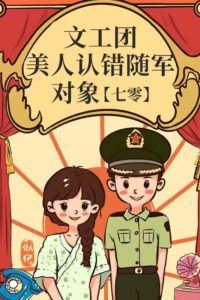
Art Troupe Beauty Mistakenly Identifies the Wrong Army Officer
Novel Info
  • Author:
  • 似伊
  • Status:Ongoing

Summary

... Read More

Meng Yingying, a professional dancer in her past life, dies and reincarnates into the body of an overweight, bullied girl with the same name in 1970s China. The original Meng Yingying was the daughter of a rural butcher, Meng Baichuan, who worked tirelessly to send her to the City Propaganda Team to learn dance, hoping she would join the prestigious Military Cultural and Arts Troupe. However, she was constantly mocked by her peers for her weight and lack of skill, and was exploited by the corrupt Director Lin, who demanded double tuition to keep her enrolled. Upon waking in the practice studio, Meng Yingying realizes she has traveled back in time to a pivotal moment. Using her professional dance expertise, she effortlessly performs complex routines that stun her coaches and classmates, proving her talent. Confronting Director Lin’s extortion, she refuses to pay the additional fees and resigns from the propaganda team, choosing to return home to her critically ill father.

Back in Mengjia Village, Meng Yingying finds her father, Meng Baichuan, on his deathbed. He is being pressured by his elder brother, Uncle Meng, and other relatives who covet the family’s two-story house. Uncle Meng proposes that Meng Yingying marry his adopted son, Dunzi, so the clan can seize the property under the guise of keeping it within the family. Meng Baichuan, knowing his daughter will be vulnerable after his death, reveals a childhood betrothal token exchanged with his former comrade-in-arms, Qi Zhenguo. He urges Meng Yingying to seek out his son, Qi Xiao’er, a rising officer in the military, to fulfill the marriage and secure her future. Meng Yingying, aware of the original story’s tragic outcome where Qi Xiao’er despises her and ruins her life, initially resists. However, seeing her father’s desperation and the predatory nature of her relatives, she agrees to the plan to protect herself and her father’s legacy.

Meng Baichuan sends a telegram to Qi Zhenguo, but receives no reply, leading him to believe the connection is severed. He then calls Qi Zhenguo directly, making a deathbed plea for his son to accept Meng Yingying. Qi Zhenguo agrees, despite his wife Chen Xiulan’s vehement opposition, as she views Meng Yingying as an unworthy butcher’s daughter who would ruin their younger son’s prospects. Qi Zhenguo firmly rejects his wife’s demands and insists on honoring the promise made to his savior. Meanwhile, Qi Xiao’er, who has a traumatic memory of being bullied by the heavyset girl in childhood, is horrified by the arrangement and desperately tries to escape the engagement, fearing a disastrous marriage.

Qi Xiao’er confides in his regimental commander, Qi Donghan, a stern and formidable man known for his integrity. Qi Donghan reprimands Qi Xiao’er for wanting to break a promise and for believing that marriage determines a soldier’s success. Unaware of the turmoil, Meng Yingying prepares to leave for the military unit. Her departure is marked by a poignant farewell with her best friend Zhao Yueru and Coach Chen, who regrets losing such a talented student. As Meng Yingying travels to Heilongjiang, she is determined to rewrite her fate. She plans to use the engagement not as a trap, but as a strategic move to gain independence and a stable position, intending to eventually cancel the marriage on her own terms while securing a career in the cultural troupe. The story sets the stage for her confrontation with the Qi family and her complex relationship with the rigid Commander Qi Donghan, who becomes an unexpected ally in her journey.

Latest Release
DateGroupRelease
2026-08-11shanghai fantasy c15
2026-08-11shanghai fantasy c14
2026-08-11shanghai fantasy c13
2026-08-11shanghai fantasy c12
2026-08-11shanghai fantasy c11
2026-08-11shanghai fantasy c10
2026-08-11shanghai fantasy c9
2026-08-11shanghai fantasy c8
2026-08-11shanghai fantasy c7
2026-08-11shanghai fantasy c6
2026-08-11shanghai fantasy c5
2026-08-11shanghai fantasy c4

Community Reviews

Rating(4 / 5.0, 10votes)
5 stars
3(30%)
4 stars
4(40%)
3 stars
3(30%)
2 stars
0(0%)
1 stars
0(0%)

Popular reviews

... Read More
Let me just say — the author knows how to paint a scene and I am HERE for it. The kitchen scene is a masterclass in sensory writing. You can literally taste that rice porridge. 'The rice porridge had cooked until the grains split open, sweet and thick in his mouth. The white peppers were a bit chewy with a muted spiciness.' I don't know about you but I immediately got hungry reading that. The author didn't just tell us the food was good — they made us EXPERIENCE it through Meng Baichuan's mouth. That's craft. Then there's the military base atmosphere, which feels completely different but equally vivid. Qi Donghan's description — 'wearing a green military uniform, the buttons of his shirt fastened neatly all the way up to his Adam's apple, impeccable and sharp. He was also very tall, standing at 190 cm, almost towering at the doorway.' This isn't just physical description, this is CHARACTER through setting. The military environment demands this kind of precision, and Qi Donghan embodies it. The hospital scene with Director Li is another gem. The way the author describes the medicine cabinet, the brown envelope, the specific drugs — penicillin, amoxicillin, Dolantin — it grounds the story in a very real, very specific time and place. This isn't a generic historical setting; it's a specific military hospital with specific resource constraints. The fact that Dolantin is 'ten times more effective than common pain relievers' but also 'addictive' — these details make the world feel lived-in and real. And the transition from the warm, intimate kitchen to the cold, bureaucratic military office to the clinical hospital — the author moves between these spaces like a camera, and each location has its own texture and mood. The worldbuilding here isn't about elaborate descriptions of castles or magic systems; it's about making ordinary spaces feel significant through the emotions happening within them.
... Read More
Okay, I need to talk about Meng Yingying and her dad because I am NOT okay after reading this. Like, the scene where she cooks for him? I literally had to put the book down and stare at the wall for a bit. She used to despise the kitchen — that's what the text says explicitly — but she goes in there anyway because her dad has no appetite and only wants strong flavors. She makes him stir-fried white peppers with preserved meat, the exact dish that would wake up his taste buds. And then she serves him rice porridge — THE fine grains they agreed were for her — and when he tries to protest, she just puts on this stern face and says 'Just eat what you're given.' Bro, I felt that. That's not stern, that's love disguised as authority. And then the part where she eats half a bowl and only tastes the preserved meat for flavor because she's worried about gaining weight for dancing? And her dad notices but doesn't say anything because he remembers the propaganda team kids mocking her? That's the kind of father-daughter silence that hits different. They're both lying to each other and both know it. But then — and this is the part that absolutely destroyed me — she leaves to 'say goodbye to Zhao Yueru' but really she's going to find doctors for him. She tells him she'll bring back fried sansa AND medicine. 'Just wait a little longer for me, just a little longer.' And the second she walks out the door, her dad vomits everything up, including dark red blood. He wipes his mouth and says 'What a waste of Yingying's effort working all morning.' WHAT A WASTE. He's been eating two bowls of porridge and then immediately puking it all back up and he's worried about WASTING her cooking effort. I'm not crying, you're crying. This is the kind of parental love that doesn't need words. The fact that he hides his vomiting, hides the blood, hides his deteriorating condition so she won't worry — that's a whole novel's worth of emotional depth right there in a few paragraphs.
... Read More
The pacing in these chapters is absolutely ruthless and I love it. Let me trace the structure: we open with the father already dying, already planning his daughter's future. No slow build, no warm-up — just immediate, suffocating stakes. Then the author does something brilliant: the telegram. He sends it. He waits three days. Three. Days. Of silence. And in those three days, the reader is sitting there thinking the same thing he is — what if she doesn't come? What if she doesn't care? Then the burning of the notebook. This is the emotional pivot point of the entire passage. Everything before it was preparation; everything after it is consequence. The father had held onto that address for nearly twenty years. Twenty years of hope. Gone in flames. And immediately after, he turns to his daughter and delivers the ultimatum: go to Qi Xiao'er or die trying. The chapter structure itself mirrors the father's deteriorating condition — short, sharp exchanges, moments of weakness (his breathing quickens, his pain flares), then forced strength. The narrative doesn't let you breathe. Just when you think the worst is over, he yells at her. Just when you think she'll comply, she refuses to leave him. And the ending — "You just fly far away, the farther the better" — followed by her saying no. The tension doesn't resolve. It tightens. The father wants her to escape; she wants to stay. Both are loving. Both are impossible. Where does this go from here? Also worth noting: the flashback to childhood — her jumping on his neck, him becoming the laughingstock — is perfectly placed. It comes right after the father presents Qi Xiao'er as the solution, and it reminds us WHY the original Meng Yingying's relationship with this boy was disastrous. The author is layering dramatic irony like a maniac and I am here for it.
... Read More
"Meng Yingying, did you hear me?" That line. That single line. The father who spent the entire conversation being gentle, wiping her tears, explaining carefully, suddenly SHOUTS. And it's the most honest thing in the entire passage. Because here's the thing about this father's dialogue — it's almost entirely subtext. He never says "I'm scared." He never says "I don't know how to protect you." He says things like "Your dad isn't even dead yet, and they're already planning to feast on our legacy" and "Not only that, your uncle also wants to match you with your cousin Dunzi." He wraps his terror in practical information. He dresses his desperation as strategy. And the daughter's dialogue is equally revealing. When she says "Dad, you tell me, if my own uncle, who shares a blood relation with me, is unreliable, can that childhood betrothed really be reliable?" — she's beating around the bush, yes, but she's also genuinely trying to reason with him. She can't tell him she's a transmigrator who knows the plot. She can't say "I read the book and Qi Xiao'er ruins my life." So she uses logic. And it works, partially. He closes his eyes and admits she's right. The most striking dialogue moment though is the pinky swear. "Pinky swear, a hundred years no changes." This is a child's promise, a game, something said between father and daughter when she was small. And now, with his finger being skin over bone, it's the most devastating thing he could possibly offer. He's giving her the only language he has left. And her response — "I won't go back on my word, Dad" — is both a promise and a lie. She doesn't know if she can keep it. The dramatic irony is absolutely brutal. The author's narrative voice is restrained, almost clinical in places, which makes the emotional moments hit harder. No purple prose, no over-explanation. Just raw, simple sentences doing heavy lifting.
... Read More
Okay I need to just... sit with this for a second. The pinky swear scene. The pinky swear scene. Meng Baichuan extends his little finger — the one that used to be warm and rough, now just skin stretched over bone — and his daughter hooks hers into it. "Pinky swear. A hundred years, no changes." And she says it back, tears falling, promising to go to Qi Xiao'er, promising to do everything he asks. But you can feel it, can't you? She's lying. Or at least, she's making a promise she knows she might not be able to keep, because the original Meng Yingying in the book DID go to Qi Xiao'er and it ended in tragedy. The daughter who has transmigrated knows this. She's caught between her father's desperate love and her own foreknowledge. What killed me was the father's internal monologue right before this. He sent a telegram to Song Fenfang — the mother, presumably — and waited three days. No reply. So he burned the yellowed notebook containing her address. "Just like the bond between him and her all those years ago — it was now completely severed." This man is dying and his first instinct isn't self-pity, it's figuring out how to protect his daughter from people who will eat her alive. He built that two-story house with military severance money, and now he's terrified it will become a target. The line that haunts me: "Dad has already prepared a way out for you." He pulls out a pocket watch — a betrothal token — and tells her to go to the boy she hasn't seen in ten years. Not because he thinks she'll be happy. Because he thinks she'll be safe. That's the kind of love that doesn't have words, it just has desperate, trembling actions. And then he YELLS at her. "Meng Yingying, did you hear me?" She's never been yelled at in either lifetime. She was always loved, always protected. And here her father is, forcing her to grow up by being cruel, because being gentle won't make her understand the stakes. His eyes redden when he looks away. He can't even bear to see her fear. I'm not okay. I'm genuinely not okay.
... Read More
I need to talk about how this chapter sequence is structured because the pacing is actually really clever and I want to unpack it. The chapter opens with Meng Yingying in the kitchen — intimate, domestic, slow. We linger there with her cooking, serving, eating with her father. It's a long, unhurried scene that makes us feel the weight of every moment. Then — BAM — she leaves and her father vomits blood. The shift from warm domesticity to visceral horror happens in a single paragraph. That's not accidental; that's the author deliberately yanking the rug out from under us. Then we cut to the military base, and the pacing changes completely. Short, sharp dialogue. Qi Donghan being annoyed. Qi Changming being frustrated. The mother on the phone laying out options like a chess game. This section moves faster, more clipped, more tense. It's a different rhythm entirely. And then there's the Qi Changming phone call with his mother — this is where the pacing really shows its teeth. The mother lays out three options, each worse than the last, and with each one, Qi Changming's conflict deepens. The scene doesn't resolve; it ends with him grippping the phone, knuckles white, wanting none of it. It's a perfect mini-cliffhanger. The Qi Donghan section that follows acts as a breather — we get his visit to Division Commander Chen, the medication request, the hospital scene. It's longer, more descriptive, more contemplative. But it builds to its own climax: 'If he can ever return to the base, I will definitely make JianShe apologize to him.' A promise of future confrontation, dropped casually at the end. What I love about this structure is that it never lets us settle. Just when we're getting emotionally invested in the father-daughter relationship, we're yanked to a military drama. Just when we're caught up in Qi Changming's romantic entanglement, we get Qi Donghan's quiet mission of loyalty and revenge. The author is playing 4D chess with reader attention and I am obsessed.
See all reviews

Characters

See all characters

Custom lists

See all custom Lists