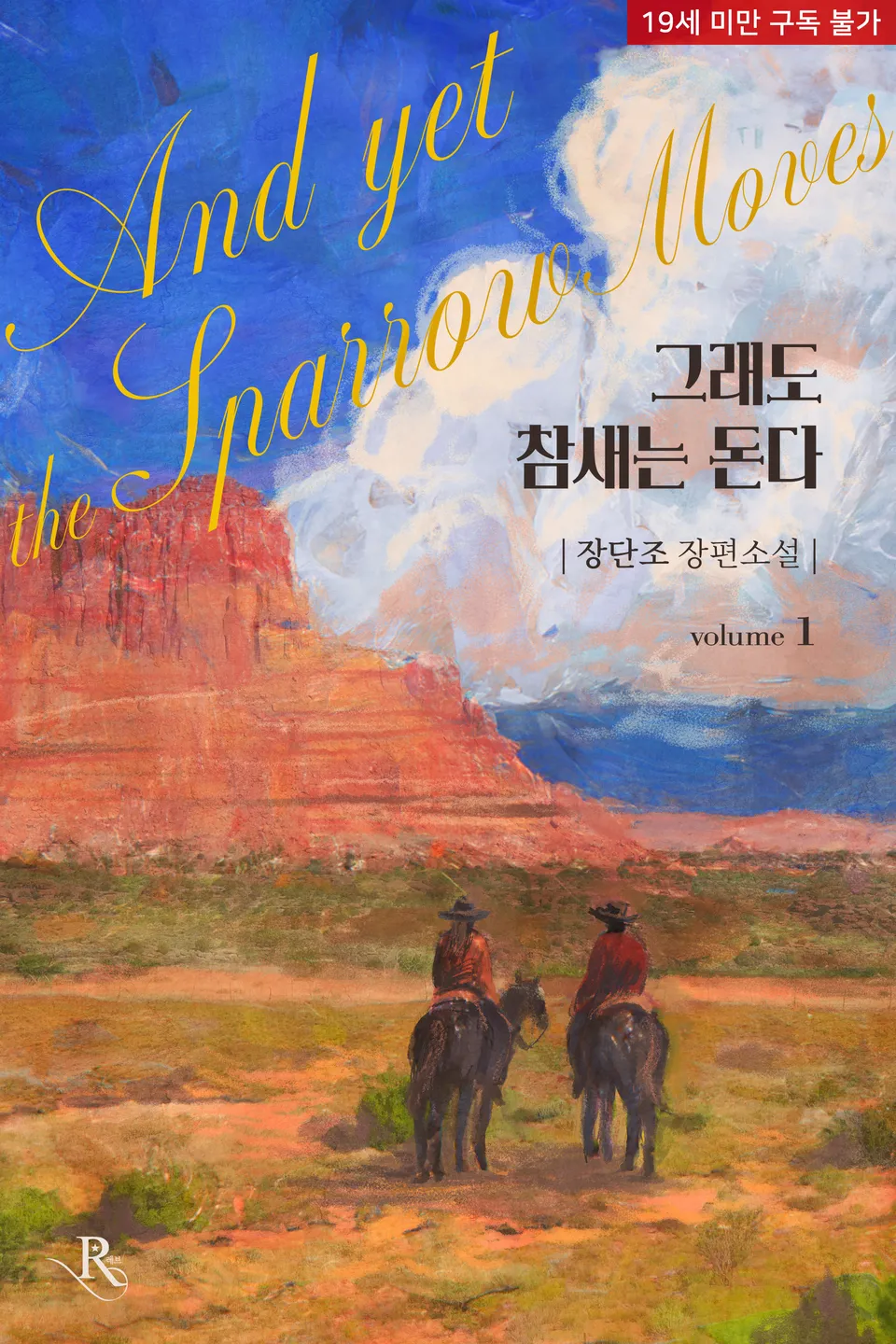
And Yet the Sparrow Moves
+Add to Custom List
Novel Info
  • Author:
  • Status:Ongoing

Summary

... Read More
Margopy Sparrow, a fifteen-year-old girl raised by her late grandmother Rosie in the remote and lawless Cosha County, struggles to balance her education in Golden Door with the harsh realities of her hometown. The region is plagued by corrupt lawmen who operate as bandits, extorting protection money from locals. Margopy takes on a job as a mail carrier for Lily Express to earn money for her studies, despite having no prior experience with supernatural entities. Her first day at the western branch of the delivery service proves traumatic when she encounters a ghost—a young priest with a crushed skull who died tragically and seeks the return of a stolen Bible. In her panic, Margopy inadvertently throws the holy book out of her dormitory window.Froy Ratel, the fierce and protective assistant manager of Lily Express, witnesses the Bible falling through his telescope. Suspecting an intruder has assaulted Margopy, he sprints to her dormitory with a rifle, driven by a possessive urgency to protect what he considers his own. Upon arrival, he finds Margopy unconscious but unharmed, and the room empty of any human attacker. As he tends to her, the ghostly priest reappears, requesting the return of his keepsake. Froy, capable of seeing spirits, reacts instinctively and fires his weapon, the bullet passing harmlessly through the ghost. This encounter reveals that the job offer Margopy accepted was not merely fraudulent but deeply entangled with local supernatural horrors.The narrative shifts to Margopy’s journey back to Cosha County, where she passes through vigilante checkpoints manned by Jackson Baker, a childhood friend who warns her to avoid the Green Pony tavern due to the presence of suspicious military cadets from the east. Upon returning home, Margopy observes the oppressive atmosphere of the town, dominated by greedy lawmen and economic decay. The story establishes a world where the boundary between the living and the dead is porous, and where human corruption is as lethal as supernatural forces. Margopy’s entry into the workforce at Lily Express places her at the center of these conflicts, as she must navigate both the dangerous duties of a mail carrier in a haunted land and the predatory intentions of the local authorities.Key turning points include Margopy’s fateful meeting with the ghost priest, which sets her on a path of supernatural involvement, and Froy’s violent intervention, which highlights his complex role as both protector and possessor. The introduction of the military cadets adds a layer of political tension, suggesting that external powers may also be moving into the region. Margopy’s determination to continue her education despite these threats underscores her resilience. The story direction points toward Margopy’s gradual acclimation to the ghostly aspects of her job, her deepening entanglement with Froy, and the escalating conflict with the corrupt law enforcement and potentially hostile military forces in Cosha County.
Latest Release
DateGroupRelease
2026-10-03dusk blossoms c2
2026-10-03dusk blossoms c1

Community Reviews

Rating(0 / 5.0, 6votes)
5 stars
0(0%)
4 stars
0(0%)
3 stars
0(0%)
2 stars
0(0%)
1 stars
0(0%)

Popular reviews

... Read More
I need to talk about Grandma Rosie for a second because this book sneaked up on me with the emotional stuff. She comes up twice in six chapters and already I feel her absence like a physical weight. First, Margopy mentions she wishes Grandma were still alive so she wouldn't have to commute to school every day. Then the blacksmith adds that she passed away 'right before you started school' and the fabric shop owner has to physically STOP him from continuing. These people are clearly protective of Margopy's feelings around this topic. And then the lawman who wanted Grandma's cow—the SAME lawman who shows up at the end demanding protection money from Peter. The timeline connects so cleanly it made my chest tight. Grandma died, someone was already eyeing her livestock, and now that person is running a protection racket in her town. This isn't just backstory. This is the inciting incident of Margopy's entire journey, and she might not even fully realize it yet. What struck me most is how quietly the grief is written. There's no dramatic funeral scene, no tearful monologue. Just a blacksmith getting his foot stomped on for mentioning it awkwardly, and Margopy making a 'sulky face' and walking away. That's how real grief often looks—in small moments of deflection and forced normalcy. The emotional core here is subtle but it's there underneath everything: a young woman navigating a world that took her grandmother, surrounded by people who care about her in different ways (Jackson's protective brotherliness, Froy's apparently long-standing devotion, her late grandmother's memory). The romance thread hasn't even properly started and I'm already emotionally invested in her happiness. That's good writing.
... Read More
I want to talk about how this author controls the pace because it is genuinely masterful and I need to understand the mechanics. Chapter 1 is a tornado. It opens with comedy (the guideline booklet), escalates to supernatural horror (the ghost), peaks with physical action (the Bible throw, the faint), cuts to a totally different POV with urgent action (Froy's sprint), and lands on a bizarre final image (a ghost asking for manners after being shot). Six major beats in what feels like fifteen minutes of reading time, and I never felt lost. The POV switch is sharp but clear—whoever is watching Margopy through the telescope becomes our secondary anchor immediately. Then Chapter 2 does something clever: it SLOWS DOWN dramatically. We're on a bumpy carriage ride, talking to a checkpoint guard, walking through a dusty town. But this deceleration isn't boring—it's strategic. It lets us absorb the world, the relationships, the history, while simultaneously stacking new questions. Why does Froy care so much? What's with the military cadets? Who is this lawman connected to Grandma? The chapter ends on a cliffhanger that reframes everything—the lawman wanting protection money isn't just a random villain introduction, it's thematically linked to Grandma's death. That's structural foreshadowing at its finest. What's impressive is that despite the rapid-fire opening, the author never rushes the emotional beats. Margopy's grief for her grandmother is handled in two brief exchanges, but they land perfectly. The pacing breathes where it needs to and accelerates where it counts. This is a book that knows exactly when to sprint and when to let you look around.
... Read More
The world this book builds is absolutely dripping with texture. Let me just start with the opening image: Margopy reading from a palm-sized instruction booklet, the 'musty smell of parchment stinging her nostrils.' We're immediately in a world where ghosts are a DOCUMENTED part of daily life, where mail carriers have GUIDELINES for ghost interaction. That's such a specific, lived-in detail. And the ghost himself—bloodshot eyes, crushed skull, wedding vestments soaked in blood. The visual is horrifying but also strangely pathetic, especially when he complains about being disrespected rather than reacting to being shot at. A ghost whose primary concern is manners and keepsake placement. Iconic. The journey to Cosha County is equally vivid. 'A shared carriage pulled by three mules'—the odd number being flagged as a bad omen by Jackson shows how deeply superstition is woven into this world. The checkpoint, the vigilante group, the military cadets from the east, the lawmen who act like bandits. Every detail paints a picture of a frontier society where the government has abandoned the periphery and people are left to fend for themselves. Cosha County itself is sketched in with economical but effective brushstrokes: 'wooden buildings lined both sides of the narrow, dirty road, each with a flimsy tent set up in front,' 'low roof and a visibly shoddy frame.' And then the train—a 'massive steam train thundered along the tracks, belching black smoke' against a 'golden wilderness'—appears almost like a vision, a symbol of change or escape or both. The sensory world here is consistently strong. I can smell the musty parchment, feel the sandy wind, hear the mules' hooves and the train's whistle. This isn't just a setting; it's a character.
... Read More
"Beautiful brother with blue eyes." — a ghost says this about Froy and I am SCREAMING. The very first thing that crosses my mind is: okay, this is romantic comedy energy and I am ready. Froy is absolutely adorable in his panic. The man goes FULL TACTICAL MODE the second he hears Margopy scream—he's calculating distances, planning to gut some intruder, vaulting fences, sprinting through the dark. And then he finds her unconscious, breathing softly, and his entire demeanor shifts. He bows his head, says 'I feel like I just lost years off my life,' kicks the Bible in frustration, picks it up with two fingers like it's disgusting, and then GATHERS HER INTO HIS ARMS. This man is a walking contradiction and I love him. But here's what actually got me—the way he handles her. He brushes her cheek, combs her hair back, pulls the blanket over her, then literally picks her up and lays her on the bed. This is someone who has done this before. Who has CARED for her before. The subtext is practically screaming at me. And then the ghost appears behind him and calls him 'beautiful brother with blue eyes' and Froy SHOOTS at it. Of course he does. The ghost is mildly offended on behalf of manners but also clearly finds the whole situation amusing. This triangular dynamic—Margopy unconscious, Froy panicking, ghost commenting from the sidelines—is the single funniest and most endearing setup I've read in forever. Margopy herself is great. She's bossy enough to yell at her boss Lily, stubborn enough to try throwing a Bible at a ghost, and vulnerable enough to pass out from fright. The fact that she's the SOLE employee at this postal branch tells me she's probably tougher than she looks.

... Read More
Okay so let me just... first of all. Chapter 1 opens with a GUIDELINE BOOKLET about not being startled by ghosts. That is such a fun hook. And then Margopy immediately fails at not being startled, which is already funny and relatable. But the real pivot is when she HURLS the Bible at the ghost and it passes right through. That moment where she can't throw the client's keepsake but then absolutely WILL throw it at a supernatural entity? Perfect character comedy gold. Then it CUTS to Froy. And I love that we get a completely different POV instantly. He's watching through a telescope, and his internal monologue goes straight to 'today is the day I break every one of that pervert's fingers.' Who IS that pervert? What does he do? I need to know immediately. The plot here is doing a LOT of work in a tiny space—introducing the supernatural element, the workplace dynamic, and this mystery protector figure all at once. The transition to Chapter 2 is a hard time/space jump back to Margopy's journey, and honestly it works because we now have context for WHY she's traveling somewhere new. The subplot threads are already visible: the lawmen who took her mule, the gang situation in Cosha County, the military cadets Jackson warned her about, and whatever relationship she has with her dead grandmother. This is a story that stacks its mysteries like pancakes and I am HERE for it. The ending of Chapter 2 with the heavyset lawman demanding protection money from Peter is such a clean way to end—it shows us the real danger in this world isn't just ghosts. It's people. And it ties back to Grandma Rosie's death from earlier. The plot is clearly building toward something bigger than a girl who delivers mail to the dead.
... Read More
The stakes in this story operate on at least three levels and they're all compelling. On the surface, Margopy's conflict is professional: she's a new mail carrier who just lost consciousness after encountering a ghost, and now she's relocating to a dangerous border town. Simple, right? Wrong. Because the deeper conflicts keep emerging. The external stakes are established quickly and effectively. Cosha County is a lawless place where 'when the federal marshals wash their hands of managing the backwater, the sheriffs turn into bandits.' Margopy has already lost a mule to toll-collecting lawmen. A heavyset, greedy officer is openly demanding protection money. The military cadets from the east are described as 'real trouble.' This is a world where danger is institutional, not incidental. But the INTERNAL stakes are what really got me. Margopy is navigating grief (Grandma Rosie), a new job in an unsafe location, and apparently a complicated history with Froy that involves him watching her from outside her window with a telescope and a rifle. That last detail is EQUAL parts romantic and deeply concerning, and I love that the text doesn't resolve whether it's protective or possessive. The ghost subplot adds another layer—this spectral figure in bloodied wedding vestments clearly has unfinished business, and the fact that he can communicate and has opinions about manners suggests he's more than a passive haunting. He's an active variable in the conflict ecosystem. What makes this work is that every conflict feeds the others. The lawlessness of Cosha County threatens Margopy's safety, which connects to her grandmother's death, which may connect to the ghost's story. The stakes are rising, interconnected, and I am deeply worried for this girl.
See all reviews

Custom lists

See all custom Lists