Summary

... Read More

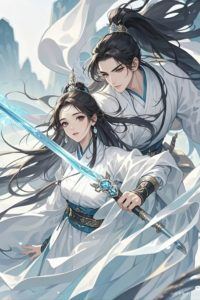
Bai Yuheng, known in the ancient era as Emperor Hengluan, was the supreme cultivator who sacrificed her physical body a century ago to seal the demonic forces threatening the world. Her soul was fragmented, with a key essence preserved by the Tianyan Sect, while another part drifted for a hundred years until it merged with a mortal girl’s body. Upon regaining her physical form, she discovers that her spiritual power is severely diminished, leaving her with only a fraction of her former strength. The primary vessel for her seal, the Four Directions Mirror, is located in the Heavenly Pivot Pavilion on Tianyan Sect’s Mount Wangxian, and its protective barriers have weakened over the decades. To investigate the mirror and the growing threat of the demons without revealing her true identity, she decides to enroll in the sect’s disciple recruitment process under her original mortal name.

During the entrance trials, Bai Yuheng effortlessly defeats numerous high-level demons, shocking the sect elders with her unprecedented results. When she tests her aptitude on the Spirit Testing Stone, the artifact explodes from the sheer density of her spiritual energy, marking her as a heaven-bestowed genius. The three reigning Emperors of Tianyan Sect—Dongxuan, Lingzhen, and Yuanguang—compete fiercely to claim her as their personal disciple, unaware that she is the very founder they revere. Bai Yuheng strategically chooses Pei Yuan, her former disciple from a century ago, to remain close to Mount Wangxian and the sealed demons. Pei Yuan, now a cold and aloof man, harbors deep resentment and jealousy, believing that his master abandoned him for the sake of the world. He has guarded her memory and her peak in isolation for a hundred years, convinced that she favored other talented individuals over him.

The core conflict arises from Bai Yuheng’s need to recover her power and secure the Four Directions Mirror while navigating the complex and hostile dynamics with Pei Yuan. She learns that rumors have spread throughout the sect claiming Pei Yuan fell in love with his master and built a tomb for her, a narrative that deeply unsettles her. As she begins her training under Pei Yuan, she maintains a facade of ignorance and humility, deliberately acting as a novice to avoid suspicion. Meanwhile, Pei Yuan struggles with his mixed emotions, oscillating between his duty as a master and his lingering attachment to the woman he believes is dead. He is particularly tormented when the Emperor’s spirit familiar, a golden snake, recognizes and bonds with Bai Yuheng, reinforcing his belief that she has moved on.

A critical turning point occurs when Bai Yuheng sneaks into the Heavenly Pivot Pavilion at night to inspect the mirror. She discovers that the seal is being actively sabotaged by a mysterious figure in black who intends to shatter the mirror and release the imprisoned demons. During her investigation, the mirror is struck by dark energy, causing it to crack and scatter into five fragments that vanish into the world, leaving only one piece in her possession. The incident draws the attention of the sect leadership, and Pei Yuan arrives to investigate the breach. He detects traces of blood and golden light, suspecting an intruder, but Bai Yuheng narrowly avoids detection by hiding her aura and claiming her injury was from a sparring accident.

The story moves forward with Bai Yuheng realizing that the demon threat is far more immediate and organized than she anticipated. The black-clad saboteur’s ability to damage the mirror indicates that the demons have allies within the cultivation world or have developed new methods to bypass ancient seals. With the mirror shattered, the remaining fragments are scattered, and Bai Yuheng must retrieve them before the enemy can use them to fully break the seal. She is forced to rely on her limited power and her new disciple, Cui Mingcan, while continuing to endure Pei Yuan’s cold scrutiny. The narrative sets the stage for a journey where Bai Yuheng must reclaim her lost strength, uncover the identity of the saboteur, and confront the emotional baggage of her past with Pei Yuan, all while keeping her true identity hidden from the sect she once ruled.

Latest Release
DateGroupRelease
2026-08-11shanghai fantasy c53
2026-08-11shanghai fantasy c52
2026-08-11shanghai fantasy c51
2026-08-11shanghai fantasy c50
2026-08-11shanghai fantasy c49
2026-08-11shanghai fantasy c48
2026-08-11shanghai fantasy c47
2026-08-11shanghai fantasy c46
2026-08-11shanghai fantasy c45
2026-08-11shanghai fantasy c44
2026-08-11shanghai fantasy c43
2026-08-11shanghai fantasy c42

Community Reviews

Rating(4 / 5.0, 8votes)
5 stars
3(38%)
4 stars
2(25%)
3 stars
3(38%)
2 stars
0(0%)
1 stars
0(0%)

Popular reviews

... Read More
I came in thinking the peach blossom demon was the villain. Then Peony laughs and says "Do you think those things we killed were people?" and suddenly the entire moral framework of this story flips. Who ARE the victims? Who ARE the murderers? Fang Wuyan—Linchun—was burned alive, driven out, called a monster, and the people who did this are the ones now dead? The demon is protecting her grave while the 'heroes' are hunting it? I'm not sure what to believe anymore and that's the best kind of conflict. And the stakes keep escalating. Gu Feng was nearly strangled. Yuan Zheng is missing. Chen Quanhai drowned. Wei Lai fell from a building. Gou Ting hanged himself. Four deaths and only two survivors, and one of them is a manipulative snake. Meanwhile Pei Yuan is playing a dangerous game with the Emperor, and Bai Yuhen's golden serpent is tracking a demon that may or may not be the bad guy. Every thread is pulling tighter. I genuinely do not know who to root for anymore and I love it.
... Read More
I have to talk about the dialogue in this because honestly, it's one of those things I rarely get excited about in web novels, but here we go. The first thing that struck me: each of the three Emperors has a completely distinct voice, and I can tell who's speaking without looking at the tags. Lingzhen is sharp, competitive, a little snarky—"You old man!" and the whole duel proposal feels like something a proud sword cultivator would say. Dongxuan is more exasperated and dry, constantly telling them to mind their dignity. And Yuanguang? He's the gentle one, the one sighing and rubbing his temples while the other two act like children. The dialogue does all that character work without needing narration to explain it. But the real standout is Pei Yuan. Look at how he speaks versus how everyone else speaks. Everyone else has full sentences, expressions, reactions. Pei Yuan? "Mm." "I cannot." "The Emperor's teachings… I barely scratched the surface." His dialogue is clipped, minimal, almost mechanical. And it tells you EVERYTHING about his emotional state without the author having to describe it. The flashback dialogue is where this really shines though. Young Pei Yuan's lines are desperate and raw: "Master, are you abandoning me too?" "So you're abandoning me too, Master?" "You can't leave me." These repeat with slight variations, and each time it hits harder. The way the dialogue echoes—that's not an accident, that's craft. The author uses repetition like a drumbeat, and by the third time we hear it, we're already bracing for impact. There's also this moment in the flashback where Bai Yuheng says "Foolish boy. If your skills are weak, practice more. Trying to trap your master? You'll need a few more decades for that!" And it's delivered with this casual warmth that makes the later tragedy so much worse, right? Because we know she's saying this before she leaves him forever. The dialogue here is doing double duty—showing their relationship AND foreshadowing the loss. One small thing: some of the crowd dialogue in Chapter 2 feels a bit generic. "By the heavens!" and "Could she be… a heaven-bestowed genius!?" are fine for background noise, but they don't have much personality. Not a big deal for a mob scene, but worth noting.
... Read More
I need to sit with this for a second because the theme of abandonment in these chapters is not subtle, and I mean that as a compliment. The central question the text keeps coming back to is: what does it mean to be left behind? And it's not just about Pei Yuan and Bai Yuheng—that's the obvious layer. The deeper layer is about duty versus love, and how the story refuses to say one is better than the other. Bai Yuheng isn't a bad master. She literally dies to seal the demons. She tells Pei Yuan to wait for her on Mount Wangxian. She strokes his hair and calls him Yuan'er with pride and sorrow in the same breath. But she leaves anyway. And the text makes it clear: she had no choice. "The world is in chaos, Yuan'er. As cultivators, we must uphold Heaven's heart." That's her duty speaking. But duty and love aren't presented as opposites here—they're both real, both valid, and both painful. Pei Yuan's silver hair is such a good symbolic detail. It turns white "with every wave of his unstable spiritual power." His body is literally reacting to his grief. The trauma isn't just emotional—it's physical, visible, permanent. And the fact that it darkens again when he composes himself? That's the story saying his pain is always there, just beneath the surface, waiting. The binding scene in the flashback is loaded with symbolism too. Pei Yuan uses a seal HIS MASTER taught him to trap her. He learned her techniques to prevent her from leaving. That's not just plot—it's the entire theme in miniature. Love as both the thing that connects and the thing that can be weaponized. The same hands that taught him everything are the hands he tries to hold onto. And then there's the Spirit Testing Stone itself. Bai Yuheng destroys it just by touching it. Her power is too much for the world to contain—a metaphor, I think, for how someone who carries the weight of sacrifice becomes almost inhuman to those left behind. She's not just a master anymore. She's a force of nature. And Pei Yuan? He's just a man who wanted her to stay. The title of Chapter 3 says it all: "You're abandoning me too, Master?" The word "too" is doing so much work there. It implies this isn't the first time she's abandoned him. Which, given the flashback, we understand on a deeper level.
... Read More
Let me just start by saying: I did not expect to be this invested in a disciple selection arc. And yet here I am, emotionally compromised by a man whose hair is turning white. The external conflicts are straightforward but well-handled. There's the competition between the three Emperors for the best disciples—it's played almost comically at times, with Lingzhen and Dongxuan nearly dueling each other. But underneath that comedy is a genuine question: who gets to shape the next generation, and what does that say about the Sect's future? The stakes aren't just personal pride—they're about the survival of different cultivation traditions. But the real conflict, the one that has me genuinely upset, is internal. Pei Yuan's struggle is the kind that stays with you. On the surface, he's being difficult—he won't take disciples, he's cold to everyone, he's refusing to engage with the Sect's needs. But the flashback reveals the wound underneath: his master chose the world over him. And now he's punishing himself for surviving it. When he says "I'm afraid my abilities are insufficient. I cannot," the stakes are enormous because we understand what he's really saying: if I'm not good enough to keep you, then I don't deserve to teach anyone else. His refusal isn't laziness or arrogance—it's grief wearing a different mask. The flashback sequence raises the stakes to a devastating level. We watch Pei Yuan go from a clever boy who can trap his master with her own techniques to a broken man whose hair turns silver. The loss isn't abstract—he literally lost the person who shaped him. And Bai Yuheng's death isn't even shown directly. We get the aftermath: "BOOM—A burst of golden light filled the sky. The backlash of her shattered soul knocked everyone to the ground." That's it. No dramatic final words, no heroic last stand. Just light and silence and a boy screaming. The suspense in the present timeline is also well-built. Every time Pei Yuan appears, we're waiting for the moment he'll crack. Will he accept a disciple? Will he speak about his master? The text gives us tiny glimpses—his gaze lingering, his voice cracking on "Master…"—and each one raises the question: how much longer can he hold himself together? What makes this work is that the author never lets us forget what's at stake. It's not just about whether Pei Yuan joins the disciple selection. It's about whether a man who was abandoned by the person he loved most can ever trust anyone again.
... Read More
Okay so let me just say this: the way this author handles pacing across these chapters is genuinely smart, and I need to talk about it because most novels would have botched this completely. Chapter 2 starts with this big public scene—the Spirit Testing Stone incident, the crowd going wild, all that energy. Then Chapter 3 immediately pivots into a flashback. Not a quick one either. We're talking a full, emotionally devastating sequence where Pei Yuan begs Bai Yuheng not to leave him, and she still goes anyway. And then—get this—we cut back to the PRESENT DAY with Pei Yuan as a grown man, silver-haired and hollow, sitting alone in a dark hall. The structure here is doing so much heavy lifting. What I love is that the flashback isn't just exposition. It's timed perfectly. We just saw Pei Yuan enter the hall in Chapter 4 with this cold, dismissive attitude toward everything, and THEN we get the origin story of why he's like that. The author withholds just enough that by the time we see young Pei Yuan kneeling and saying "Master, are you abandoning me too?"—it hits like a truck. The pacing of the reveal is basically: show us the scar, then show us how it happened. Also, the scene transitions are surprisingly smooth. The shift from the chaotic disciple selection (Emperors almost fighting over who gets Bai Yuheng) to the quiet arrival of Pei Yuan is handled with a single line: "a new presence quietly entered the hall." That's it. One line, and the entire mood shifts from comedic rivalry to something heavier. The author trusts the reader to feel that shift without over-explaining it. The only thing I'd nitpick is that Chapter 3's flashback, while powerful, does pause the forward momentum pretty hard. But honestly? It's earned. The tension from the Spirit Testing Stone explosion needed a release valve, and the author chose emotional weight over more action. I think that was the right call. If this had kept going at full speed, we'd have burned out by Chapter 5. The cliffhanger at the end of the excerpt—Pei Yuan saying he can't take disciples because his abilities are "insufficient"—is a great structural beat. It raises the question: is he being honest, or is this a wall he's built? And the fact that Yuanguang "hadn't"... the text cuts off right there, which is a classic chapter-end technique. I immediately want to read the next part.
... Read More
I need to talk about the dried lake scene because WOW. The author described it like this: a lifeless lake, an ancient peach tree in full bloom, petals cascading like soft rain over a single grave. Mountains walling the area on three sides, shrouded in perpetual shade and cold stillness. Do you understand what this does to me? This is not just a setting, this is a mood, this is a CHARACTER. The contrast between the dead lake and the living tree, the white stone grave with red ink, the woman in red emerging from behind it—it's like a painting. I could literally see this as a film scene. And then there's the Xuan Shen Hall with Yuan Guangdi grinding herbs, the thick scent of medicine, the swirling steam from the cauldron. Completely different atmosphere but equally vivid. The author never forgets to ground us in sensory details. Even the mundane moments—Cui Mingcan bumping into Granny Yang, the red embroidery fabric falling to the ground—these small visual anchors make the world feel lived-in. This isn't a generic xianxia backdrop, it's a place with texture and weight.
See all reviews

Characters

See all characters

Custom lists

See all custom Lists