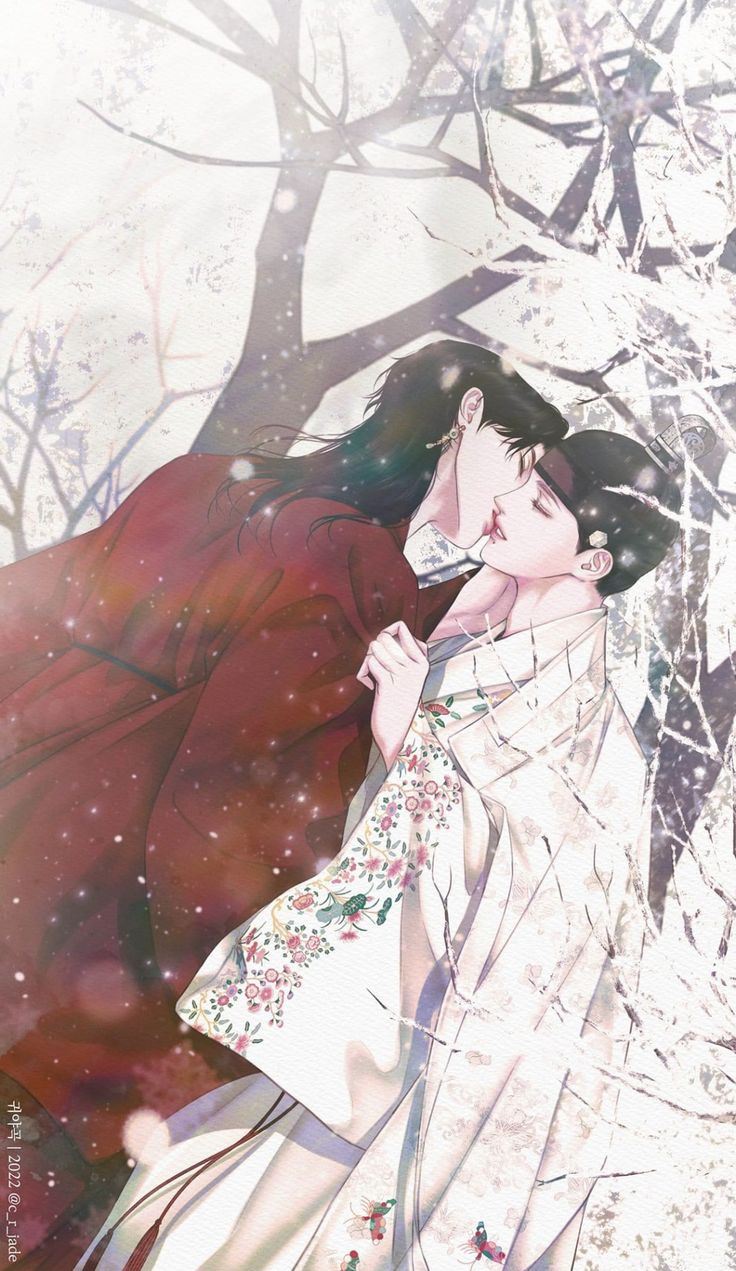
This chapter is a masterclass in domestic worldbuilding, you know? Like, the author doesn't just dump descriptions on you—they weave everything into the rhythm of daily life and it just… clicks.
Let me start with the morning scene. Qingyan comes out, sits on Qiu Henian's lap, shows him his sore mouth. The detail about the unused ointment under the bed? Tiny, but it tells you so much about their living situation. They have a bed, they keep medicines, there's intimacy in the clutter. And then that one line—"Qingyan's collar revealed his fair and tender neck, his back slim under the thin clothing, the natural hollows forming ambiguous shadows beneath his robe." I actually had to re-read that twice. It's not even trying to be erotic, it's just… there. A plain observation of a body in morning light, and it carries so much weight after the previous night.
Then we move to Liu Fa's house and the kang scene. The heated platform where the women sit, picking red dates and lotus seeds for the wedding. I love how the author uses this domestic space to introduce Shen Min—this gaunt man in patched cotton, keeping his head down, the son of Wang Heyao. He's there physically but emotionally somewhere else, and the contrast between the warm, busy preparation for Liu Cai's wedding and Shen Min's hollow silence is devastating.
And the new house! The vermilion-painted furniture, the snowy white walls, the empty bed waiting for the bride's bedding. "All three rooms faced the courtyard and had their own entrances." This isn't just set dressing—it's Qingyan's envy bleeding through the narration. He's looking at this fully realized, happy domestic scene and thinking about how his own marriage was special but different, how they didn't have these elaborate preparations. The world feels lived-in because we see it through Qingyan's eyes, not some omniscient narrator's camera.
The tofu shop, the river, the village of two hundred households—all of it accumulates into a sense of place that feels real. This isn't a generic ancient Chinese village. It has specific smells (the pickled vegetables, the porridge), specific sounds (the commotion when Young Master Wang arrives), and specific textures (patched cotton, vermilion paint, the bitter taste of ointment). The author makes the ordinary feel sacred, and that's why I keep coming back to these chapters.