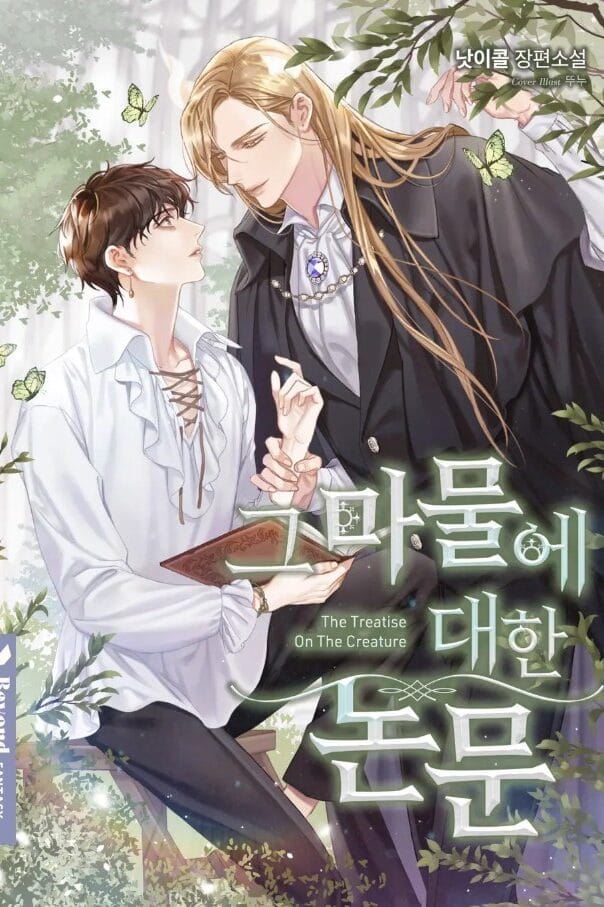
A Thesis on Magical Creatures
+Add to Custom List
Novel Info
  • Author:
  • Status:Ongoing

Summary

... Read More

Yoo Tae-oh is a dedicated biology graduate student who enters the research lab of a renowned professor, envisioning an ideal academic environment. Instead, his expectations shatter as he discovers his role has devolved into menial servitude. For over a year and five months, he survives on coffee and meal replacement jellies while running errands and completing non-academic tasks. His advisor, a man he once admired, forces him to read and summarize fantasy novels to bridge a generational gap with his estranged teenage son. Tae-oh dutifully complies, though he secretly finds profound fascination in the fictional magical creatures described within the texts, meticulously compiling a personal encyclopedia of these beasts rather than organizing character arcs as instructed.

The narrative shifts dramatically when the professor demands an immediate review of Tae-oh’s long-delayed thesis draft. While rushing to meet his advisor at a nearby café, Tae-oh is struck by a vehicle and loses consciousness. He awakens not in a hospital, but in a dense, untamed forest surrounded by knights in medieval plate armor. A knight captain interrogates him aggressively, demanding knowledge about a dangerous magical creature spotted nearby. Despite the threat of execution, Tae-oh recognizes the beast as an Opalus, a Level 2 magical creature from the fantasy novel he was forced to read. His detailed knowledge of its behavior and anatomy saves his life, though the captain reveals he was originally destined for death after spilling tea on Count Ameli’s shoes. Tae-oh realizes he has transmigrated into the very novel he studied, becoming an unnamed servant in House Ameli.

Adapting to his new reality, Tae-oh endures a month of grueling manual labor within the Count’s mansion. He finds solace only in the library, where he secretly reads works by Diabel Asrein, a celebrated professor and genius scholar within the novel’s universe. Asrein serves as a beacon of academic passion for Tae-oh, representing everything his real-world advisor failed to be. When news spreads that Professor Asrein is visiting the mansion to investigate magical creature sightings in the territory, Tae-oh sees an opportunity to escape his drudgery. He visits a local bookstore to purchase a gift for the professor, hoping to establish a connection. There, he encounters a mysterious, tall figure in a hooded robe who helps him select a children’s book titled Magical Creatures for Beginners, claiming Asrein does not own it. Unaware that the stranger is the professor himself, Tae-oh returns to the mansion with the gift.

During the reception, Count Ameli humiliates Tae-oh in front of Asrein, orchestrating a scenario to punish him for a previous infraction. The Count forces Tae-oh to recite his knowledge of the Opalus, intending to expose him as a liar. However, Tae-oh’s accurate and passionate explanation captivates Asrein, who praises the servant’s analytical mind. In a cruel twist, the Count deliberately trips Tae-oh, causing him to spill tea on Asrein’s coat. Enraged, the Count threatens to throw Tae-oh to the mountain beasts. Before his fate can be sealed, Asrein intervenes. He logic-traps the Count by reminding him that Tae-oh’s knowledge was previously deemed valuable enough to spare his life. By claiming Tae-oh as a research assistant, Asrein rescues him from execution.

As they travel to Angelus University, Asrein explains his motivation. He has lost fourteen previous students because they lacked desperation; they were content with their status and unwilling to endure the dangers of field research. Tae-oh, having nothing and willing to risk everything for the chance to learn, represents a unique experiment. Asrein promises to provide Tae-oh with the resources and opportunities he lacked in his previous life. Upon arrival at the university, Tae-oh suffers severely from motion sickness due to the rough carriage ride, ending his introduction with a comical display of physical distress. Asrein welcomes him to the Department of Magical Creatures, marking the beginning of Tae-oh’s journey from a exploited servant to a dedicated researcher under a mentor who values intellect over lineage.

Latest Release
DateGroupRelease
2026-10-03dusk blossoms c173
2026-10-03dusk blossoms c172
2026-10-03dusk blossoms c171
2026-10-03dusk blossoms c170
2026-10-03dusk blossoms c169
2026-10-03dusk blossoms c168
2026-10-03dusk blossoms c167
2026-10-03dusk blossoms c166
2026-10-03dusk blossoms c165
2026-10-03dusk blossoms c164
2026-10-03dusk blossoms c163
2026-10-03dusk blossoms c162

Community Reviews

Rating(0 / 5.0, 40votes)
5 stars
0(0%)
4 stars
0(0%)
3 stars
0(0%)
2 stars
0(0%)
1 stars
0(0%)

Popular reviews

... Read More
Okay so let me just say this chapter sequence is absolutely RIPPING along and I couldn't put it down. The whole setup with the Monster Encyclopedia is brilliant but what really hooked me was the disappearance of that Ameli letter. One second it's right there on Asrein's desk, sealed with a red lily wax seal — obviously important, obviously secretive — and the NEXT second it's GONE. Vanished. And then BAM, the black rabbit shows up with it in its mouth like some kind of magical cat burglar. "Asrein, who doesn't even want to share a meal with him, wouldn't personally write letters to the Count. Then what is this?" This detail is doing SO MUCH WORK for the plot. It immediately tells us there's a whole hidden layer to Asrein's relationship with House Ameli that we haven't seen yet. The letter disappearing isn't just a cute magical creature moment — it's a mystery bomb that's going to explode later. And the way the author structures the chase scene is genius. First you have the tension of searching for the letter, then the eerie encounter with the rabbit in the shadows, then the transformation into a cat, then the physical exhaustion of chasing it across campus. Each beat raises the stakes a little more until finally — "Agnus?" — the reveal hits and everything clicks into place. The encyclopedia entry confirming it's a dangerous magical creature that 'guides the way with secrets' is the perfect button on this whole sequence. I'm dying to know what those secrets are.
... Read More
There's a symbolism in this story that hit me harder than I expected on first read. The protagonist's thesis—the thing he was supposed to be working on, the thing that represents his academic life and future—literally scatters in the air like flower petals when he gets hit by the car. That image stayed with me. His entire academic struggle, his hard work, reduced to paper flying everywhere in a moment. And then he finds himself in a world where the fictional creatures he was cataloging for his professor become real. His "Monster Encyclopedia"—the detailed notes he took instead of the character summaries his professor actually wanted—becomes his survival tool. The thing he did for his own curiosity, the thing that wasn't his official assignment, is what saves his life. Isn't that a commentary on how academia often works? The protagonist wasn't doing research. He was running errands for someone else's interests. The professor wanted literary knowledge, wanted to bond with his son, wanted companionship for his readings. But the protagonist—driven by genuine curiosity, by the biology student in him—was taking notes on magical creatures instead. Those notes, the ones that didn't serve anyone's official purpose, become the most valuable thing in this new world. There's also the name Diabel Asrein—the fictional professor from the novel. A genius from five generations of noble scholars. The protagonist compares him to his own advisor with a bitter smile. The fictional professor represents what real mentorship could be: knowledgeable, respected, leading by intellectual merit. The real professor represents exploitation disguised as favor. Both are called "professors." Both hold power over the protagonist. The difference is night and day. The theme of knowledge as power runs through everything. In the modern world, his knowledge is useless because his professor won't let him use it. In the fantasy world, his knowledge is his only protection. The novel seems to be asking: what is the point of accumulating knowledge if no one lets you apply it? And then there's the irony of the protagonist being able to do real research here—surrounded by creatures that should be impossible, in a world where a Level 2 dangerous magical beast exists—while in his own world he couldn't even get his advisor to acknowledge his thesis. The universe gave him exactly what he wanted, just not through the path he expected. This is basically a love letter to every graduate student who's ever been made to do someone else's work while their own research gathers dust. It's darkly funny, deeply relatable, and somehow hopeful too. The world he's in now might be dangerous, but at least his knowledge has value here. That's... pretty profound for a story that starts with someone getting hit by a car while carrying his thesis draft.
... Read More
"An enormous zelkova tree, reminiscent of Yggdrasil embracing the world." I read that sentence three times. The author just dropped Norse mythology into a fantasy university greenhouse and I am not okay. The imagery throughout this passage is genuinely cinematic — Red flowers covering the fields, vines climbing tree trunks, tiny fruits resembling powdered snow. It's lush without being overwrought, and the fact that it's all contained within a glass dome that somehow seems to emit its own light gives it this otherworldly quality. But what I love most is how the worldbuilding is embedded in action. We learn about the ban on magical creature hunting, the bounty system, the opposition from hunters who lost their livelihoods, Evgenia I discovering medicinal properties in creature remains, the shift from extermination targets to protected research subjects — all of it delivered while walking down a path. No info-dump energy. It feels like eavesdropping on a conversation. And the greenhouse itself functions as a narrative device — it's a sanctuary, a hospital, a research facility all in one. The Dandel creature clinging to Jin during an expedition, the Kiko predators nearby, the fact that these creatures are treated with such careful respect rather than fear. This world feels lived-in and historically layered. The prose doesn't just describe a fantasy setting, it makes you believe this place has centuries of accumulated conflict and compromise behind it.
... Read More
Let's talk about tension, because this passage is a masterclass in how to escalate stakes without ever raising your voice. The opening conflict is immediate and visceral: our protagonist is trapped in the Count's mansion, about to be handed over as an apprentice against their will, and has zero power to stop it. The Count is sweating, lying, trying to maintain his pride while being systematically dismantled. Our protagonist is watching this unfold from a position of utter powerlessness, and the suspense comes from a simple question: will Asrein actually follow through? Will this work? Every line of dialogue between Asrein and the Count is a move in a chess game where our protagonist is the piece being fought over. But then the stakes shift internally. Once Asrein wins, the external conflict resolves—and that's when the author introduces a far more uncomfortable tension: the personal one. The carriage ride. The conversation about family. The protagonist realizing that Asrein is also alone, also rootless. This is where the story stops being about 'will they get out of this situation' and becomes 'who are these people, and what happens when two damaged individuals become connected?' The stakes aren't about survival anymore—they're about trust, hope, vulnerability. And then the ending slaps you in the face. We're told this lab has 'accumulated resentment of past graduate students.' The stakes just went from personal to existential. Whatever happened to the previous students—it wasn't just academic pressure. The word 'resentment' implies something darker, something that breaks people. Our protagonist is walking into this with nothing but determination and a shabby cloth bag, and I am absolutely terrified for them. The author has done something brilliant here: they made us care about the small conflict (getting out of the Count's house) and then revealed that the bigger conflict is far worse than we imagined. And yet, the protagonist's response isn't fear—it's 'Yes, Professor!' They row toward the storm instead of away from it. That's the kind of ending that makes you immediately open the next chapter.
... Read More
I want to talk about color symbolism in this section because it keeps coming back and I think it's deliberate. Yellow is EVERYWHERE. The yellow wildflowers Tae-oh uses to lure Dandel. The yellow pollen coating the white fur. The yellow spots on Asrein's cheeks. And then—Asrein's golden irises. These aren't coincidences. Yellow/gold has been associated with warmth, hope, and something precious throughout the narrative, and this section crystallizes that beautifully. Dandel's characteristic—that it decorates itself with yellow pollen 'when it meets someone it likes'—is essentially a metaphor for affection made visible. The creature literally shows its feelings through color. And Tae-oh, who has been gray and drained ('no color in your face'), rediscoversthrough this small magical interaction. Then there's the Sarracenia—the 'red flower' that looks unremarkable but is worth 1.8 million won and could kill you if eaten raw. It's a symbol of hidden value, of things that appear ordinary but contain extraordinary power. The mysterious young man wanting to consume it raw is almost symbolic too: someone willing to endure pain for what they need, not understanding the proper way to process suffering. The parallel between Tae-oh's relationship with Asrein and his relationship with Dandel is worth noting. Both involve Tae-oh offering something (knowledge/care) and receiving unexpected affection in return. Both require patience and attention to detail. The theme of 'growth through attention' runs through all of it.
... Read More
Let me just say this - the way the protagonist interacts with Asrein is SO much more interesting than your typical fantasy novel would have it. You've got this servant who literally worships Asrein, and then they bump into him in a random bookstore in a quiet neighborhood, completely unrecognized. The power dynamic is fascinating because on paper, Asrein could have them thrown in a dungeon or executed, but instead he's actually... helpful? He recommends a children's book about magical creatures to the protagonist. At first I was like, wait, that's weird - giving a professor a kids' book as a gift? But then the protagonist mentions that their Count has a massive collection of Asrein's works and they spend their free time reading them, and it hit me - this is basically someone telling their crush they already know about their hobbies. It's awkward and endearing and so human. Then the scene where Asrein finds out they're a servant and specifically at Count Ameli's place - you could feel the shift. The Count is a monster. Earlier they mentioned he buried someone alive for incompetence. And here's this servant, trying to pursue their dream of becoming Asrein's student, about to be thrown into the lion's den. And don't get me started on the Count's manipulation - he summons the protagonist under the pretense that Asrein is interested in them, only to use it as an opportunity to humiliate them publicly. That's some next-level psychological abuse. He even brings up the old tea incident, framing it as deliberate disrespect when it clearly wasn't. The Count is playing 4D chess with this person's life.
See all reviews

Custom lists

See all custom Lists