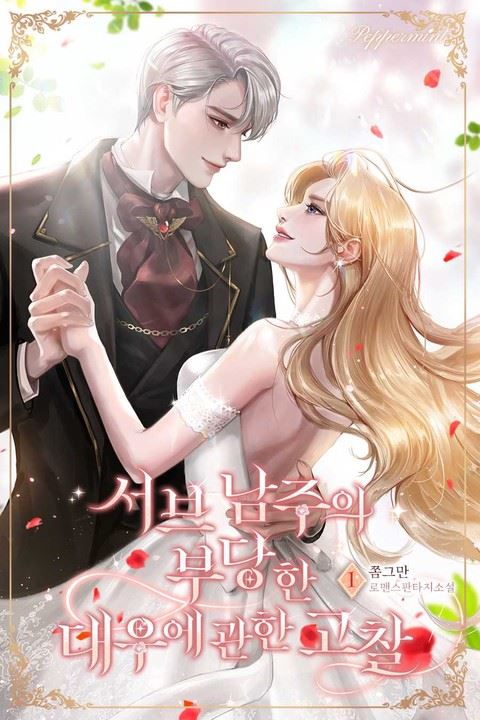
A Study of the Second Male Lead’s Unfair Treatment
+Add to Custom List
Novel Info
  • Author:
  • Status:Ongoing

Summary

... Read More
Edna Whitteger is a young noblewoman from Saluga, a powerful trading house that has sustained the empire for centuries. In her previous lives, she became engaged to the Crown Prince out of love, gave her family's gold and business to him, and watched as he systematically destroyed the Whitteger family, killing her stepmother Katrina, her siblings, and everyone she loved. The cycle always ended with her death on a battlefield, only to be reborn again with fragmented memories until the final life.This time, Edna wakes after her father's sudden death in a carriage accident and realizes the Crown Prince is behind it. He has proposed to her older sister Marian, who already loves another man, but his true target is Saluga's wealth. When Marian refuses, the Crown Prince shifts his attention to Edna. Remembering her past, Edna decides to break the cycle by accepting a marriage proposal from Duke Ian Lombardi instead—a man she previously considered an enemy, the Emperor's illegitimate son who lives in a dilapidated mansion and is targeted by assassins sent by the Empress and Crown Prince.Edna approaches Katrina, her stepmother, and proposes a plan: marry Ian to buy time, enter Saluga's business to prepare for the future, and use Ian as a shield while she builds strength. Katrina supports the decision. Edna visits the Lombardi estate, finding it in disrepair with rusted gates and no guards—Ian survives only through his own swordsmanship despite constant assassination attempts.During her visit, Lady Molly from the Empress's palace arrives unexpectedly with gifts that are actually a test of loyalty. Edna confronts her with a sword, revealing her engagement to Ian and refusing to be intimidated. She exposes that the desserts came from "Olitte," a bakery owned by Saluga, demonstrating she has already begun gathering intelligence and leverage. Edna tells Henry, Ian's aide, that she intends to become the head of Ian's household and manage his affairs, signaling her determination to change their shared fate. Throughout the chapters, the story establishes Edna's transformation from a naive woman who sacrificed everything for love into a strategic planner willing to use marriage as a tool for survival and revenge against the Crown Prince who destroyed her family.
Latest Release
DateGroupRelease
2026-10-03dusk blossoms c8
2026-10-03dusk blossoms c7
2026-10-03dusk blossoms c6
2026-10-03dusk blossoms c5
2026-10-03dusk blossoms c4
2026-10-03dusk blossoms c3
2026-10-03dusk blossoms c2
2026-10-03dusk blossoms c1

Community Reviews

Rating(0 / 5.0, 50votes)
5 stars
0(0%)
4 stars
0(0%)
3 stars
0(0%)
2 stars
0(0%)
1 stars
0(0%)

Popular reviews

... Read More
I have to give massive credit to the author's dialogue work because every single character has a distinct voice and I could tell who was speaking without looking at the tags. Henry's dialogue is fast, slightly defensive, and full of that person-who-knows-theyre-smart energy. Watch how he explains himself: "I carried them out fair and square. When no one was around." The fact that he immediately contradicts himself and doesn't even realize it is perfectly in character. He's the smartest person in the room but socially clumsy, and his dialogue reflects that — he overshares, he rambles, he justifies things that don't need justifying. The head maid is the perfect counterpoint. Her lines are always short, calm, and devastating. "You are being disrespectful toward someone who may very well become the duchess." Said quietly. No anger needed. Ian's voice is different again — he's more measured, more formal, and when he's flustered you can hear it in his stammering. "Oh, I, well." That's not a prince or even a duke speaking confidently, that's a guy who'd rather be doing literally anything else. And Edna's dialogue is remarkably sparse but loaded. She barely speaks but when she does, every word is calculated. "No matter how long I deliberate, my decision will be the same. Mother." Short. Final. Unshakeable. The narration itself also has a really distinctive voice — dry, slightly ironic, never over-dramatic even when describing horrifying things like imperial concubines or assassination attempts. There's a line where Henry threatens to report the violence to the security bureau and the narration immediately undercuts it: "He knew well enough that it was an unspoken rule of the security bureau not to get involved in petty disputes within noble households." That's the author winking at you, saying I see what you're doing and I'm in on the joke. The tone never wavers from that perfect balance of warmth and wry observation.

... Read More
Let's break down what just happened in this chapter because oh my god. Roderick gets notified by a messenger about his sister's engagement and his immediate reaction is to abandon his afternoon lectures and storm into his stepmother's quarters. No knocking. No preamble. Just 'Is it true?' and then a full family intervention. But here's the thing — the plot keeps layering reveals on top of each other and I cannot catch my breath. First it's the engagement news. Then Edna explains WHY she did it: because staying passive like Marian did won't work long-term. Then she drops the BOMBSHELL that the entire Whitteger family is essentially being milked by the Imperial House for gold. Every year, enormous amounts, given out of habit, fear, and the implicit threat that if they don't pay, someone dies. 'We are the Imperial House's golden goose.' I mean. That line alone reframes literally everything about this story. And the political chess game Edna is playing?! She knew that if she just sat still and waited, the Crown Prince would eventually force his way anyway — except he won't propose to HER because she's not as beautiful as Marian, and that would shame him. So she SEIZES the narrative by engaging to Ian Lombardi, the Emperor's illegitimate son, someone equally controversial, someone who carries his own set of enemies. Now nobody touches her because touching her means touching Ian, and touching Ian means picking a fight with the Duke faction. Meanwhile, the subplot with Tennyson goes completely sideways in the most interesting way. His father's gambling debts, the secret meeting in that grimy alley, the whole 'a womanizer son and a gambling father' energy. The text cuts off right as he enters the building, but you can FEEL the tension. Something is about to happen there and I am not prepared. The plot structure here is masterful. Every conversation opens up new layers of intrigue instead of closing them. It's like peeling an onion and each layer makes you cry more.
... Read More
Can we just talk about Edna for a second because this woman is not playing any games whatsoever. The way she assesses Ian's estate — the rusted gate, the dead trees, the weeds choking what used to be a pond — she doesn't flinch. She just takes it all in and makes a decision. 'There is nothing to single out. From beginning to end. That might actually make it easier.' This is a woman who walks into ruin and sees opportunity. Absolute legend behavior. And then there's her dynamic with Katrina — mother and daughter, but more like two generals plotting a war. Katrina starts resistant, clearly exhausted, pressing her fingers to her forehead like she can physically push through the stress. But Edna just dismantles every objection with cold logic: 'The Crown Prince is a hundred times more dangerous than Duke Ian.' She's protecting her family, yes, but also proving herself. Meanwhile Thomas, the escort, is just standing there carrying three boxes of gold like a good little soldier while internally questioning every life choice that led him to this moment. The relationship dynamics here are so rich — everyone is playing multiple roles simultaneously.
... Read More
I need to talk about Henry Bern because this guy is absolutely hilarious and also deeply tragic and I am obsessed with him. He's the top graduate of the Academy, turned down the Imperial House to serve Ian — someone the Crown Prince apparently coveted too, which already tells you something about the dynamic between these two. And yet here he is, getting hit in the back of the head with documents and books by the head maid every time he opens his mouth about Edna being "rough and fierce." The running gag is funny, sure, but there's something genuinely sad underneath it. Henry is the only realist in the ducal house. He sees clearly that Ian is being targeted daily by assassins and poisoned food, and still Ian clings to this idea of his "brother" — apparently a complicated relationship with royalty or the imperial family. Henry's loyalty isn't blind devotion; it's chosen. That's what makes it matter. And then there's the whole scene where he brings Ian stolen (he insists it's not stolen — "I carried them out fair and square when no one was around" — sure, Henry, sure) fashionable clothes because Ian has nothing. The fact that Ian actually tries on the outfit and looks ridiculous in a red beret but goes anyway shows how much he trusts Henry, even when Henry's judgment on non-strategic matters is questionable. Their relationship is the emotional anchor of this whole setup — a brilliant man choosing loyalty over power, and a duke who has nothing left but that loyalty. I also love how Edna and Katrina's relationship plays out here. Katrina raised Edna even though she's not her biological child, and after her death, Edna still calls her "Mother" with genuine warmth. That single word carries so much weight.
... Read More
Can we appreciate how distinct every single voice is in this text? I read it aloud at one point and honestly could've guessed who was speaking just by listening to the sentence structure. Roderick: fast, exclamation-point-heavy, full of rhetorical questions and dramatic interruptions. 'Hey! Where are you going? Roderick Whitteger! Don't you have afternoon lectures?' This is a man who talks in bursts. He doesn't get to the point — he ORBITs the point until the point has no choice but to appear. His internal monologue is equally frantic: 'Of all things to inherit, he had to take after the most troublesome part!' The exclamation marks ARE his personality. Katrina: cool, measured, devastating. 'Though I did not give birth to you, if you behave this rudely, I have the power to ensure that not a single word you want to hear reaches your ears.' She doesn't raise her voice. She doesn't need to. Every sentence is a quiet threat wrapped in perfect grammar. And then later: 'What a thing to say.' Four words. Absolute dominance. Edna: playful on the surface, razor underneath. 'Brother, please calm down.' *pours tea* 'This is no time for games!' 'Oh! There seems to be a misunderstanding.' She shifts tones like a chameleon, and the reader only catches it on reread. Her explanation of the political situation is the most densely written dialogue in the chapter — long, flowing, almost lecture-like — which makes sense because she's the smartest person in the room and she knows it. Tennyson: his dialogue is almost nonexistent in this excerpt, which is interesting. He's mostly DESCRIBED rather than heard. 'A womanizer son and a gambling father!' muttered gloomily. His voice comes through more in action than in speech, which somehow makes him feel even MORE mysterious. The narrative voice itself is this omniscient第三人称 that dips into characters' heads without warning, giving us their rawest thoughts alongside their polished dialogue. Sometimes it's almost cruel about it — like when it immediately undercuts Roderick's self-image as a self-made professor. The narration doesn't just tell you what's happening, it tells you what the characters are LYING TO THEMSELVES about. This is not a book where dialogue does the heavy lifting. It's a book where the NARRATIVE VOICE is doing something spectacular.
... Read More
Okay, can we talk about the sunlight scene for a second? Because I absolutely lost it. "The sunlight coming through the window barely reached as far as where Edna was standing. The rest of the space was submerged in a comfortable shade. Yet to Edna's eyes, it seemed as though the area around Ian was shimmering with a bright light." I read that three times. Three. Times. This is the kind of writing that just gets inside you and rearranges things. It's not overwrought or melodramatic—it's understated in the perfect way. Edna seeing Ian literally glowing in her perception? After everything? After years of her being the one who steps forward, the one who offers chocolate and asks questions no one else thinks to ask? The emotional arc here is so beautifully paced. We go from political exposition (the Imperial House demands) to personal confession (Edna's simple desires) to historical context (the banquet memory) to this quiet revelation where Ian realizes he can be her protector. And through it all, the romance never feels forced. It's built on mutual observation, on years of noticing each other in crowded rooms. What kills me is how natural it feels. These two aren't dramatic about their feelings. Edna doesn't confess love; she confesses wanting ordinary life. Ian doesn't declare devotion; he offers protection. But that's what makes it hit so hard. It's not about grand romance—it's about two people who've found in each other something the world keeps trying to take away. And then Tennyson ruins the moment. Of course he does. Life does that, doesn't it? Just when you think you've found your quiet happily-ever-after, someone knocks on the door ten times (or once, let's be honest) and spills the beans.
See all reviews

Custom lists

See all custom Lists