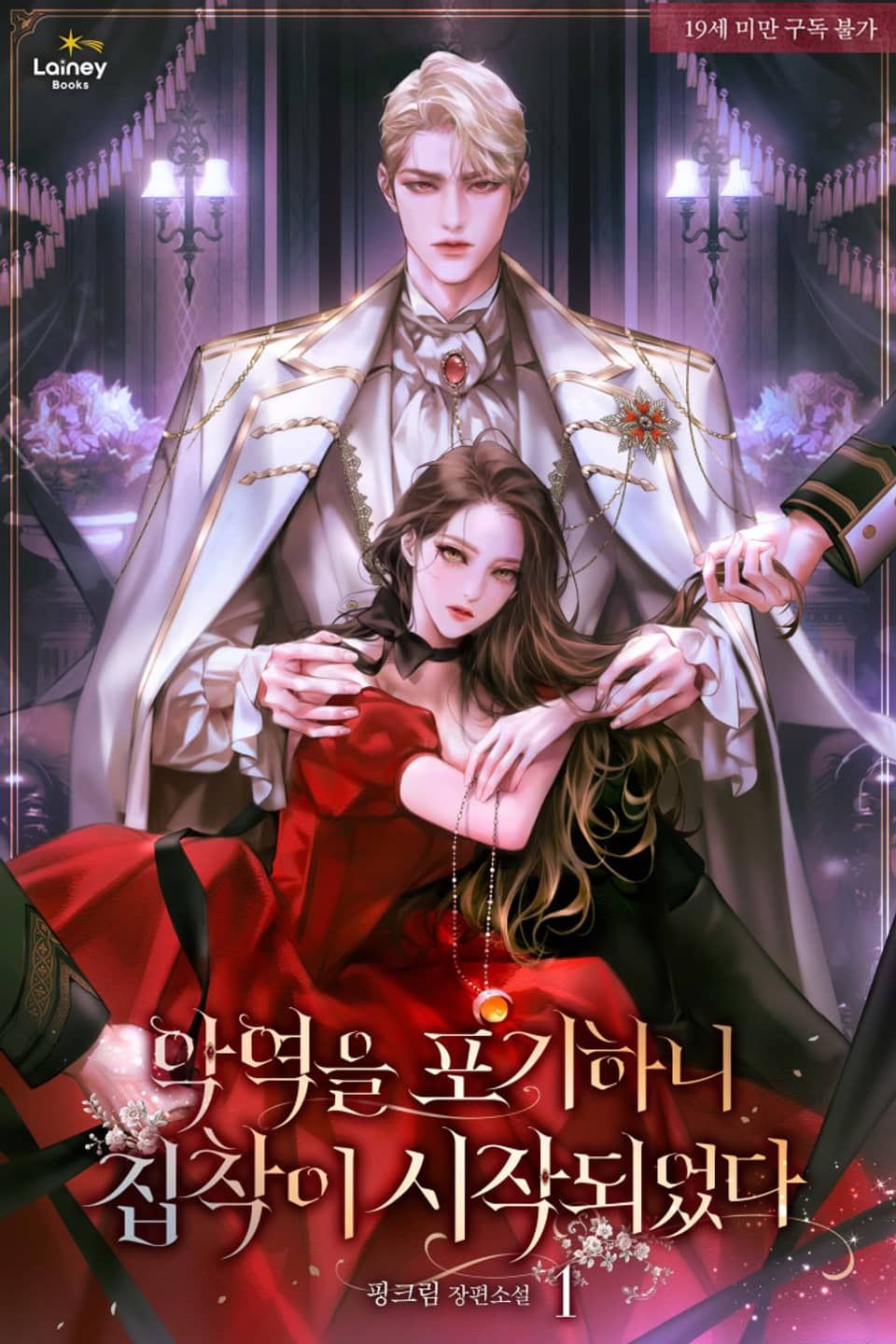
A Memoir of Unrequited Love for His Holiness
+Add to Custom List
Genres:
Novel Info
  • Author:
  • Status:Ongoing

Summary

... Read More

Cynthia Dernier, the only daughter of a wealthy Count, lived a privileged life in the capital but became fixated on an impossible object of affection: Ezekiel, the Pope of the Grand Temple. At age ten, she encountered him during a religious blessing ceremony and was instantly captivated by his divine beauty and serene demeanor. For the next seven years, Cynthia pursued him with relentless determination, attending every mass, donating enormous sums to have her name carved into temple walls, and staging chance encounters outside the sacred grounds. Despite her persistent advances, Ezekiel remained cold and detached, treating her with polite indifference and consistently redirecting her affections toward the Goddess Lena.

The turning point arrived when Cynthia witnessed Ezekiel smiling warmly at a duke's daughter during a public meeting. The contrast between his usual icy exterior and this bright, genuine expression shattered her decade-long fantasy. She realized that to Ezekiel, she was not merely uninteresting but entirely insignificant. Overwhelmed by despair and unable to continue her unrequited devotion, Cynthia abruptly ended her social life and fled to a neglected seaside villa under the guise of organizing her feelings before an arranged marriage. She left behind her childhood friend Michael and her entourage, seeking isolation to let her lingering attachment dissolve in the ocean waves.

However, her retreat was short-lived. On her first night at the villa, a frantic knocking interrupted her solitude. When Cynthia opened the door, she found Ezekiel standing there, breathless and visibly distressed. His demeanor was radically different from the composed Pope she had known for years. He accused her of abandoning him, expressing anguish that she would leave without a word to marry another man. Before Cynthia could process his words, Ezekiel pulled her into a passionate, possessive kiss, claiming that her departure had shaken his very faith. He then made an explicit proposition, offering himself to her completely, and carried her into the villa.

Through flashbacks, the narrative reveals the depth of Cynthia's obsession and the subtle dynamics of her relationship with Ezekiel. It is disclosed that Ezekiel had secretly observed her from afar, recognizing her presence at the bookstore and cafe during his rare outings. He had noticed her buying the same book he was reading and heard her confession that she loved him recklessly, even if it was a poisoned chalice. Despite his vows, Ezekiel had been silently watching her, and his composure had been eroding under the weight of his own suppressed desires.

At Cynthia's debutante ball, Ezekiel appeared in person, breaking protocol to bless the young nobles. He locked eyes with Cynthia across the crowded hall, his gaze intense and unmistakable. When he left the ball, Cynthia followed him into a private guest room. Instead of rejecting her, Ezekiel trapped her against the door, his anger and jealousy palpable. He confronted her about her intentions, his usual restraint stripped away. Cynthia confessed her love one final time, hoping to secure a response, but Ezekiel's reaction indicated that their relationship was entering a turbulent new phase defined by mutual obsession rather than pious distance.

The story shifts from a simple romance to a complex exploration of power, faith, and desire. Ezekiel, the embodiment of religious purity, is revealed to be governed by earthly passions he can no longer suppress. Cynthia, who thought she had lost him forever, finds herself the center of his chaotic attention. The narrative sets up a conflict between Cynthia's societal role as a noblewoman destined for marriage and Ezekiel's sacred position, both of which are now threatened by their undeniable connection. The sea, once a symbol of escape, becomes the backdrop for a collision between two people who have defied their expected paths.

As the initial shock of Ezekiel's visit fades, Cynthia must navigate the aftermath of his confession of need. The Pope's arrival at her secluded home signals that her attempt to move on has failed, but not in the way she feared. Ezekiel is no longer the distant figure ignoring her; he is an active, demanding presence. The story moves toward a confrontation with their societal constraints, as Ezekiel's actions risk his reputation and Cynthia's future. Their dynamic has shifted from one-sided adoration to a volatile, reciprocal entanglement that challenges the very foundations of their respective worlds.

Cynthia's parents, initially supportive of her retreat, remain unaware of the Pope's sudden appearance. The秘密 of Ezekiel's visit must be kept, adding tension to their interactions. Meanwhile, rumors begin to circulate in the capital about the Pope's unusual behavior and his attention to the Count's daughter. The narrative explores how Cynthia's identity is reconstructed through Ezekiel's gaze; she is no longer just a fan but the object of the Pope's fixation. This shift empowers her but also places her in danger, as Ezekiel's devotion comes with possessiveness and volatility.

The climax of this section establishes the central conflict: two souls bound by fate but separated by vow and station. Ezekiel's admission that Cynthia shook his faith suggests that his love for her is interpreted as a spiritual crisis or a test of his devotion. Cynthia, meanwhile, must decide whether to accept this dangerous love or return to the safety of obscurity. The story ends with the implication that their separation is impossible, setting the stage for a struggle against religious and political forces that seek to keep them apart.

Latest Release
DateGroupRelease
2026-10-03dusk blossoms c18
2026-10-03dusk blossoms c17
2026-10-03dusk blossoms c16
2026-10-03dusk blossoms c15
2026-10-03dusk blossoms c14
2026-10-03dusk blossoms c13
2026-10-03dusk blossoms c12
2026-10-03dusk blossoms c11
2026-10-03dusk blossoms c10
2026-10-03dusk blossoms c9
2026-10-03dusk blossoms c8
2026-10-03dusk blossoms c7

Community Reviews

Rating(0 / 5.0, 37votes)
5 stars
0(0%)
4 stars
0(0%)
3 stars
0(0%)
2 stars
0(0%)
1 stars
0(0%)

Popular reviews

... Read More
I started this batch going 'okay it's just a romance setup' and ended up unable to look away. The pacing choice to OPEN with 'ten years' of love already established is genius because it means we don't get the boring courtship phase — we land directly in the consequences. By chapter 7 we're already deep in territory where a normal person would have moved on, but Cynthia has converted her entire existence around this one man. Then the structure does something really clever: it slows down for the micro moments (the chocolate, the name being called out at mass, the bookstore browsing) and then accelerates rapidly through her escalation. Bribe priests → learn schedule → follow him → buy his book → sit near him in a cafe. Each step takes one paragraph. TheMichael interlude in the middle acts as a breather but also a catalyst — his thirty minutes of gushing about kissing literally changes Cynthia's entire trajectory. And that last line of the batch where Ezekiel opens THE SAME BOOK she bought and she thinks 'Could this be fate?' — that's a cliffhanger disguised as a thought. The author is playing 4D chess with pacing here and I respect it.
... Read More
I NEED to talk about the kiss scene. Because I read it and then I read it again and I still don't know how to process what just happened. Ezekiel literally says "let me show you what really being shit is like" and then kisses her. Like. CONQUERS her lips. Tongue involved. And the narration has Cynthia's body betraying her—her legs give out, her mouth waters, she's trembling. Meanwhile she's thinking "is this my first kiss?" after ten years of pursuing him! The emotional whiplash between these two is INSANE. On one side you have Cynthia, who spent a DECADE defining herself around this person, who got so devastated she essentially self-exiled to a broken-down seaside villa to die alone. On the other side, Ezekiel—who seemingly felt NOTHING for ten years—suddenly can't function without her, tracks her down at midnight, and grabs her like he's starving. "You've shaken my faith in the goddess herself… Leaving without a word like this—do you think it wouldn't drive me mad?" That sentence. That whole sentence. He's admitting she matters more to him than his entire religious devotion. He's admitting obsession. And then he goes straight to sexual territoriality. This man is a walking contradiction and I am OBSESSED.
... Read More
'For nine long years, Cynthia had clung to him, and even then, he had found it burdensome to offer her even the smallest of smiles.' I need a minute. That one line carries the entire weight of this novel's emotional core. Nine YEARS. And the math of it is just devastating—she's been dedicating her life to someone who can barely tolerate her presence, and now she's watching him give away the version of himself she's been starving for to a stranger. The physicality of her reaction is what gets me. She has to 'muster every bit of strength' just to hold back tears. She's biting her lip. Her whole body is trying to compress an emotion that big into something small enough to hide. And all because she saw a smile she'd never seen directed at her. That's the thing about unrequited love—it's not just about wanting someone. It's about wanting to be the person who makes them feel the way they make you feel. Also, the maids calling Ezekiel an 'impotent bastard' because he's not responding to Cynthia's most scandalous outfit? I literally laughed out loud. Sometimes the supporting characters say what we're all thinking. These maids would literally pluck out Ezekiel's hair if it meant getting him to pay attention to their miss.
... Read More
Let me think about the stakes here because they're stacked absurdly high and most of it is invisible. ON THE SURFACE: A noblewoman has a crush on a clergyman. Cute, right? Wrong. Ezekiel is destined to become the Pope. Marriage is impossible. Even unofficial relationships are scandalous. The previous Pope had spectacular romantic affairs that adults still discuss with clicking tongues. Cynthia would be destroying her family's reputation, her own social standing, possibly her life. BUT THE REAL STAKES are deeper. Look at what Cynthia actually says at the end: "I don't know whether this is due to fate or not. I also can't guarantee whether I've submitted to fate or not." She's not just confessing love. She's confessing surrender. She knows the cost. She's choosing it anyway. That's the highest-stakes moment in any romance — not the kiss, not the grand gesture, but the quiet admission that you're walking into fire and you don't care. And then Ezekiel's response? Nothing. Zero. The fact that he can't even give her the dignity of a rejection means Cynthia is carrying the entire emotional weight alone. She's fighting a war against an enemy that won't even acknowledge she's there. The stakes escalate even further with the seven-year gap. She's not giving up — she's just changing tactics. The veiled appearance, the maid consultations, the elaborate preparations. Every attempt is higher stakes because each failure costs her more hope.
... Read More
There's this one line that just destroyed me: “The first row made her neck too sore from looking up at Ezekiel, and below the third row interfered with appreciating Ezekiel's beautiful face.” Seven years. She has had the SAME SEAT for SEVEN YEARS. This isn't just a habit, this is architecture. She has built an entire emotional life around the geometry of watching this man from exactly the right angle. And what does he see when he looks out at the congregation? Does he see her? The text says no, and that's the quiet devastation of it. Cynthia's emotional journey in this chapter goes from manufactured confidence (“Today will be different!”) through genuine anxiety (the staring nobles, the veil hiding her eyes), to desperate performance (clutching her hands, pretending to pray while secretly plotting how to look good), to hollow defeat (Ezekiel doesn't even look at her), and then… she pivots. Hard. To chocolate. To Michael. To the debutante preparations. It's actually incredibly human how quickly she redirects herself rather than sitting with the failure. That said, the moment where she thinks “what if Ezekiel worries about her?” and then immediately shuts it down because “he probably wouldn't care at all”—that tiny flicker of hope followed by such brutal self-correction? That's the kind of emotional honesty that makes this book so good. It's not melodramatic. It's just a girl who has loved someone invisibly for seven years and is trying every strategy she knows, one after another, like throwing different keys at a locked door.
... Read More
This section of the novel is doing some serious pacing work and honestly? It's masterful. The author takes us from this incredibly intimate, almost breathless scene between Ezekiel and Cynthia (you know, the whole 'exercise restraint' thing) and then just... pivots. The very next beat we're at a party, Cynthia is trying a completely new strategy, feeling rejected, and stumbling into the most devastating emotional discovery of the arc. The transition from the temple Mass scenes—which are basically routine, almost mundane—to the party feels deliberate. We get these small repeated interactions ('Yes, Young Lady') that establish the new normal, and then BAM, Cynthia decides to escalate. The author uses the party setting to compress a huge emotional journey: hope → rejection → curiosity → devastation, all in what feels like one evening. What really sells the pacing is that the revelation at the curtain isn't rushed. It builds through audio first—we hear Ezekiel's voice before we see it—then we get the visual, then the emotional gut-punch. By the time Cynthia is biting her lip, the chapter has already done so much damage. And the ending? It just stops right there, mid-breakdown. Perfect.
See all reviews

Custom lists

See all custom Lists