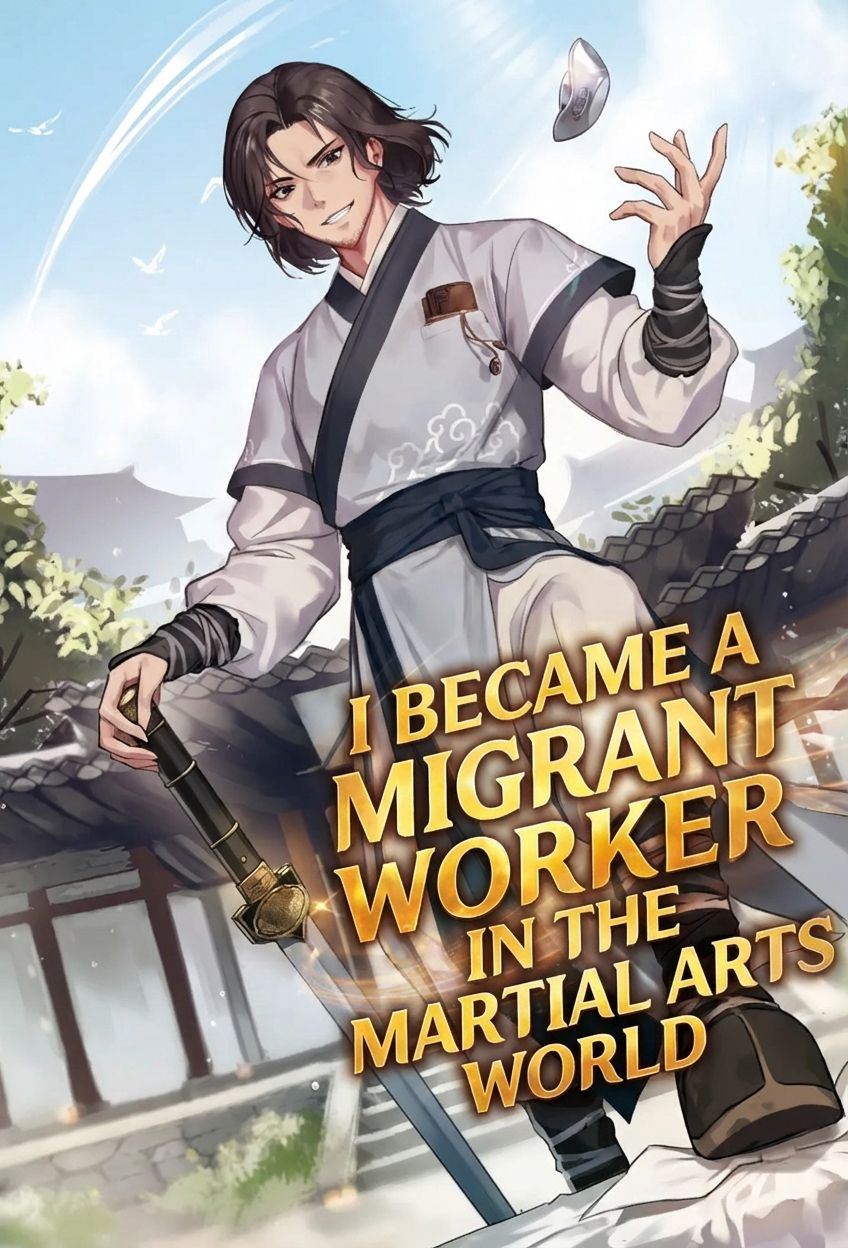
I Became a Migrant Worker in the Martial Arts World
+Add to Custom List
Genres:
Tags:
Novel Info
  • Author:
  • Status:Ongoing

Summary

... Read More
Seong Ra-jun was a Korean office worker in his late twenties who fell through a manhole on his way to a job interview and woke up in the Murim, a martial arts world set in Ming Dynasty China. He had no knowledge of martial arts initially and spent his first year starving, begging, and selling wild herbs to survive. By his third year, he had worked as a porter for various escort agencies, enduring the brutal conditions of the martial world where human lives were cheap. The story opens during a surprise bandit attack on an escort mission at Mugang Mountain. While other escorts fight skillfully, Ra-jun barely survives by using basic fighting techniques and a trick he calls Twin Swallow Flight, throwing two daggers in quick succession to kill a pursuing bandit. After the battle, five porters and four escort warriors are dead. The escort chief wisely retreats, and during the forced march to safety, Ra-jun befriends an escort warrior named Sa-ma Yul, who notices his combat ability.Upon reaching their destination in Maeyang County, Ra-jun earns two silver taels from his porter work. Instead of spending it on immediate comfort, he decides to invest in his future. He realizes that to become a proper escort warrior and advance his career, he must overcome the Wall of Lamentation, a limit that prevents most martial artists from advancing beyond one year of internal energy accumulation. Without breaking through this wall, he will remain limited in his abilities and have no path upward. He purchases a Ten-year Fo-Ti, a potent medicinal herb that can add approximately one year of internal energy to his cultivation. After consuming the herb and enduring excruciating pain as the vital energy assaults his body, he successfully circulates the energy through Qi Circulation Training over several hours. He breaks through the one-year wall, achieving two years of internal energy. His sensory perception sharpens, and his physical strength significantly increases.With his new abilities, Ra-jun decides to pursue employment as an escort warrior. He understands that in this world, connections matter more than credentials, so he cultivates a relationship with Sa-ma Yul through drinking sessions and gifts of Korean cotton fabric provided by the Joseon Hometown Association, a secret organization of Korean expatriates. He greases the wheels with a bribe equivalent to seventy thousand to eighty thousand won in modern currency. Sa-ma Yul promises to recommend him to the Baekwoon Escort Agency. Two days later, Ra-jun attends the job interview, which is conducted by Baek Reung-hwa, the White Phoenix, a member of the Nine Dragons Seven Phoenixes, an elite group of young martial artists recognized by the Murim Alliance. She is also the third daughter of the Baekwoon Escort Agency head. Ra-jun delivers a polished interview, using carefully prepared stories about his background as a military veteran from Yeoncheon and his reasons for coming to the Ming Dynasty. He emphasizes his ability to read maps, a rare skill in this era. Baek Reung-hwa and the escort chief are impressed by his oratory and competence. They discuss the possibility that he might be a refugee from a Joseon political coup, but Baek Reung-hwa dismisses this, noting that true royalty would display innate dignity he lacks. They hire him, seeing a talented individual worth retaining.Ra-jun begins his training at the Maeyang County branch of Baekwoon Escort Agency. The first day involves grueling interval training, running exercises that test their stamina to the breaking point. Despite his enhanced physical condition, he struggles to keep up with the other recruits during the initial runs. After training, he meets his fellow new hires, a group of rough-looking men with troubled pasts. Their oldest and most skilled member, Gwak Du-san, produces liquor, and they bond over drinks. The story follows Ra-jun as he navigates the harsh realities of the martial world, aiming to build a stable career as an escort warrior while concealing his true origins and modern sensibilities in a world that views foreigners with suspicion.

Latest Release
DateGroupRelease
2026-10-01dawn translations c130
2026-10-01dawn translations c129
2026-10-01dawn translations c128
2026-10-01dawn translations c127
2026-10-01dawn translations c126
2026-10-01dawn translations c125
2026-10-01dawn translations c124
2026-10-01dawn translations c123
2026-10-01dawn translations c122
2026-10-01dawn translations c121
2026-10-01dawn translations c120
2026-10-01dawn translations c119

Community Reviews

Rating(0 / 5.0, 32votes)
5 stars
0(0%)
4 stars
0(0%)
3 stars
0(0%)
2 stars
0(0%)
1 stars
0(0%)

Popular reviews

... Read More
I need to talk about Sa-ma Yul. Just... one paragraph about him because something about that scene hit me in the chest and I can't stop thinking about it. The protagonist gives him cotton fabric — which, as the text points out, is basically cash — and Sa-ma Yul's EYES TURN RED. Not a smile, not a thank you, his WHOLE FACE changes. And then he says something that sounds so simple: "where did you get the money for something like this?" But that's not really about the money, is it? It's about being SEEN. This guy is working class, probably tired, probably doesn't get treated with this kind of deliberate generosity all that often. The protagonist doesn't just bribe him like a transaction — he wraps it in family language, calls him "brother," mentions the NEPHEW, makes it personal. And Sa-ma Yul feels that. The red eyes are the moment where the transaction becomes human. What gets me is how casual the whole thing is written. No big dramatic music, no inner monologue from Sa-ma Yul's POV. Just two guys drinking, one giving something precious, the other almost crying over it. And then later, we find out the Association paid for the drinks too. So the protagonist orchestrated this entire emotional exchange and neither of them fully knows how deep it goes. That's... that's actually kind of beautiful in a really messy, complicated way.
... Read More
Let me just start by saying: the opening lines about village wars set the entire tone for me. 'It might sound cute to say villages are at war, but in reality, it's an incredibly vicious war.' — This is the author establishing ground rules in three sentences. No fairy-tale village rivalries here. These are thousand-person brutal conflicts. The world operates on violence as a first language, and the MC's immediate reaction — 'I had no desire to get caught up in such a terrible affair, so I decided to stick to being a bodyguard' — tells us everything we need to know about both the setting and the protagonist's survival instinct. Then the Jeong Family Estate reveal is *chef's kiss*. Dozens of tiled-roof houses 'as big as a whale's back.' That image — a house compared to a whale — immediately places this in a world where wealth is measured in physical scale and agricultural abundance. The comparison to an armory for the security level? Perfect. This isn't a rich family; this is a fortified compound. The servant details are what really sell it for me. Whistles around their necks, spears in hand, on patrol. These aren't decorative guards — they're a functional security apparatus. And the whistle system implies coordinated communication, a hierarchy of response. When the manager mentions blowing the whistle to summon the Ten Great Masters, it paints a picture of layered defense: low-level servants handle perimeter, elite masters handle breaches. The world feels engineered, not decorative. The martial arts power scaling through internal energy is also elegantly handled. Instead of exposition dumps, we get it through the MC's self-assessment: two years of internal energy, needs ten for sword qi. That's worldbuilding through character limitation, which is far more engaging. And the casual reference to 'Ten Great Masters of Hubei' — a regional collective of elite fighters — makes the martial world feel vast and interconnected without needing a single paragraph of explanation.
... Read More
I need to talk about the protagonist because this is genuinely one of the most realistically portrayed transmigrators I've ever read and I've read A LOT. On paper, he should be insufferable. Modern guy in ancient world, he has all this knowledge, he should be some arrogant genius who looks down on everyone. Instead? He's a porter. A literal cargo bearer. He adapted. Three years he's been surviving, learning, hustling. He calls himself adaptable and honestly the text PROVES it. He goes from job-hunting in the modern world to surviving in Murim and not only does he survive, he figures out how to not die immediately. That's not luck, that's competence. And here's the thing that got me—the bloodlust is NOT there. He kills this bandit, stomps his head, kicks his eyeball flying, and I genuinely thought he was going to be fine with it. But no. After thirty knee kicks and the guy stops moving, he just... feels bitter. Like drinking tasteless coffee. Not guilt exactly, not even remorse, but this deep existential disgust at a world where a human life is worth a few copper coins. That single line—"A world where a person's life is so cheap that killing someone only leaves you with the bitterness of drinking bad coffee"—that is CHARACTER DEFINING. That's not the internal monologue of a killer. That's the internal monologue of someone who had to become hard to survive but hasn't gone fully dark. Also the Sa-ma Yul interaction was surprisingly warm. This escort warrior actually compliments our MC, asks about his background with genuine curiosity, and they end up chatting amiably while searching for a campsite. For a moment it felt like two guys who just went through hell finding some normal human connection. I hope we see more of this relationship develop because right now it feels like the only friendly one in this entire story.
... Read More
Let's be real — most novels could cut this entire section in half and nothing would change. But this author? They're playing 4D chess with pacing. Look at the structure: Chapter opens mid-conversation, already in motion. No establishing shot, no "our protagonist woke up and decided to..." We're dropped into a drinking session that's already happening. The protagonist is already performing, already calculating. By paragraph three we learn he has a plan. By paragraph ten we know the plan involves a hidden card. By paragraph fifteen the card's been played and we're getting the payoff. Then — cut to the night walk. Sudden shift in tone, slower pace, the suspense builds through stillness rather than action. Someone's following him. He notices. He doesn't run. He sets a trap by simply stopping and speaking. This is pacing as POWER MOVE. Then the interview — and here's where it gets clever. The author could've rushed through the resume questions, the standard interview beats. Instead they spend time on the ROOM, the SEATING, the hierarchy. We learn about the Nine Dragons Seven Phoenixes title through his internal comparison to baseball's Rookie of the Year — a modern reference that instantly grounds the fantasy element in something we understand. The interview hasn't even started and we already know more about this world's power structure than most novels do in fifty pages. The chapter ends on a question mid-sentence. Not a cliffhanger — just... a pause. Like the story is comfortable enough with us that it doesn't need to threaten us to keep us reading.
... Read More
The pacing of these chapters is unhinged in the best way possible. It starts with the protagonist's RESUME. Literally his job application statement about adaptability. And I'm sitting there like... is this going to be a workplace comedy? Because that's what I thought. Then it cuts to "Die!" and an axe coming at his face. The whiplash is deliberate and it works perfectly because it mirrors what the protagonist is experiencing—he walked into this world and immediately his life is threatened. The reader learns nothing about this world before being thrown into violence. The fight itself is paced like an action sequence in a thriller. Quick sentences. Sound effects. Fragmented thoughts. "Crack!" "Whoa!" It's breathless and that's intentional. You feel the panic. Then after the adrenaline dump, there's this long stretch of procedural aftermath—roll call, casualty count, tactical retreat, finding a campsite. It's deliberately slower, almost documentary-like. The tension dissipates but a new kind of tension replaces it: the uncertainty of WHY this ambush happened and WHAT it means for the story going forward. The chapter structure is basically: hook → violence → processing → mystery → temporary safety. That's a solid rhythm. But here's where I have a tiny note—the section about beggars feels slightly disconnected from the main thread. It's worldbuilding, sure, but it comes right at the end after we've already established safety. It reads a bit like the author forgot to include it earlier and just tacked it on. Not a dealbreaker, but noticeable. Still, the overall pace keeps me turning pages. Every section earns its place even when it's breathing room.
... Read More
I want to talk about how the author manages information flow because honestly, it's impressive. We open with worldbuilding noise — village wars, general brutality — and the MC's pragmatic withdrawal from it. Quick. Three sentences. We're not stuck in exposition purgatory. Then the Sa-ma Yul exposition dump about Jeong Chu-san's marriage troubles. This is the longest single block of backstory in the chapter, and it works because it's delivered through dialogue, not narration. The cackling, the casual delivery, the bracketed cultural notes that feel like the translator wink-ing at the reader — it all keeps the pace moving even though we're getting a dense info-dump. The key is that it's framed as gossip, which is how people actually absorb this kind of information in real life. Then we cut to the estate. Visual. Immediate. The whistles, the spears, the hierarchy. After all that backstory, we're suddenly *in* the scene, testing the security. The pacing breathes here — we're not just hearing about the world, we're walking through it. The contract scene is where the pacing tightens. Every question the MC asks reveals another layer: first about the threat, then about the martial arts level, then the contract terms. And each answer opens a new door instead of closing one. Manager talks about the portrait → MC gets hostile toward the rival → Manager reveals Jeolgeom's desperation → MC asks about martial level → Jwa Gun-pyeong finally speaks about the real stakes. The chapter ends on that note about the second son being a prodigy granted the sect's name at fifteen. That's a perfect cliffhanger — not a dramatic 'to be continued' moment, but a quiet revelation that recalibrates everything. The threat we were told was 'not that serious' just became seriously threatening. And the MC is still signing contracts like nothing happened. The contrast between the escalating stakes and the protagonist's casual acceptance is what makes the pacing feel so natural — we're running while he's strolling.
See all reviews

Custom lists

See all custom Lists